The legs are often the first place you notice aging: climbing stairs feels harder, getting out of a chair takes more effort, and long walks start to seem out of reach.
The good news? You don’t need a fancy gym or intense workout to turn things around. A simple leg exerciser for seniors, like a pedal machine, seated elliptical, or resistance band, can quietly rebuild strength, improve circulation, and boost confidence in everyday movement.
In this guide, you’ll learn why leg strength matters so much as you age, what types of leg exercisers actually help. We’ll show you how to choose the right one, and how to build a safe routine you can stick with for the long term.
Why Leg Strength And Circulation Matter More As We Age
Your legs do far more than help you walk. Strong, well-circulated legs support your independence, protect you from falls, and even influence your heart and brain health.
How Aging Affects Legs, Balance, And Mobility
Starting around your 30s and 40s, you naturally begin to lose muscle mass. By your 60s and 70s, this loss can speed up, especially in the legs. Without resistance training:
- Gait (walking) speed slows, making everyday tasks and crossing streets more difficult.
- Balance declines, you may feel wobbly stepping off a curb or reaching for something overhead.
- Standing up becomes harder, rising from a chair, toilet, or car seat can feel like a mini workout.
Research shows that age-related muscle loss in the legs strongly affects balance, chair-rising ability, and walking speed. The encouraging part: resistance training can reverse much of this. Even in older adults, strengthening the legs improves mobility and reduces fall risk.
Benefits Of Regular Leg Exercise For Seniors
When you regularly use a leg exerciser for seniors, pedaling, stepping, or doing resistance moves, you’re doing much more than “moving your legs.“ Studies on older adults show that consistent lower-body training can:
- Increase leg extension strength by over 50% in as little as 6 weeks
- Boost hamstring (curl) strength by around 30%
- Help maintain leg strength for years when heavier resistance is used consistently
- Reduce joint pain and stiffness, especially from osteoarthritis, by gently lubricating the joints
- Lower the risk of osteoporosis by placing healthy stress on the bones
- Improve blood flow to the legs, which supports heart health and reduces swelling
Beyond the numbers, people often report very real, daily-life wins:
- Walking through a grocery store without needing to rest
- Getting up from a chair smoothly instead of “pushing” themselves up
- Feeling more secure on stairs or uneven ground
Risks Of Inactivity: Muscle Loss, Falls, And Poor Circulation
On the flip side, staying mostly sedentary accelerates the very problems you’re trying to avoid.
Lack of leg exercise can lead to:
- Faster muscle loss (sarcopenia), which makes daily tasks harder and more tiring
- Higher fall risk, weak legs and poor balance are a major cause of fractures and hospitalizations
- Poor circulation, more swelling, cold feet, and discomfort when standing
- Higher levels of visceral fat (fat around the organs), which is linked with diabetes and heart disease
The takeaway: if you can safely move your legs, even at a low intensity, doing something regularly is far better than waiting until you “feel stronger.“ The movement itself is what helps you get stronger and more stable.
What Counts As A Leg Exerciser For Seniors?
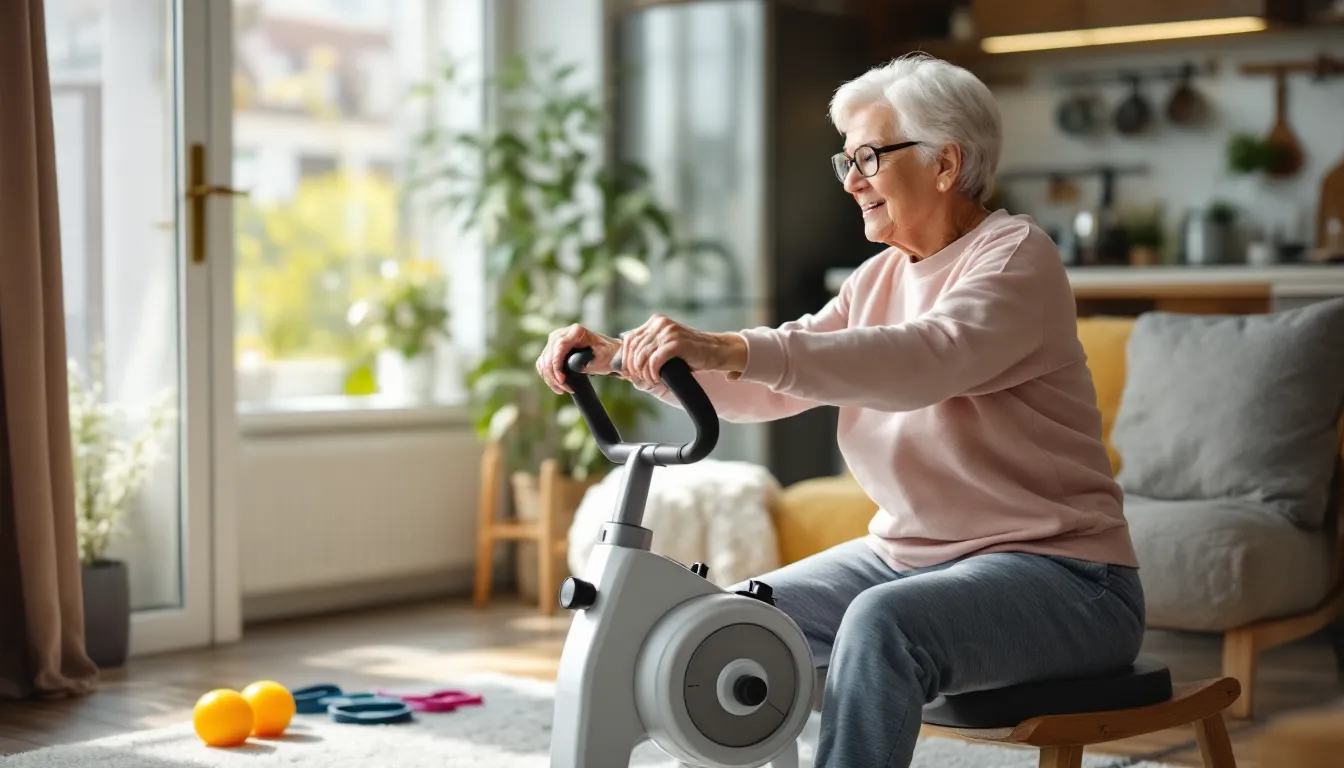
A “leg exerciser” doesn’t have to be complicated. It’s simply any tool that lets you work your lower body safely and consistently.
Common Types: Pedal Exercisers, Mini Bikes, And Under-Desk Machines
These are some of the most popular options for seniors and for caregivers setting up home exercise:
- Pedal exercisers / mini bikes
Small devices you place in front of a chair. You sit and pedal like a bike.
- Great for: low-impact cardio, circulation, gentle strengthening
- Pros: affordable, compact, easy to use while watching TV or reading
- Tip: Look for non-slip feet and adjustable resistance.
- Under-desk pedal machines
Similar to mini bikes, often a bit smoother or heavier.
- Great for: people who sit a lot (at a desk, in a favorite chair)
- Pros: quiet options are ideal if you share space
These are often the easiest starting point if you’re new to exercise or returning after illness or injury.
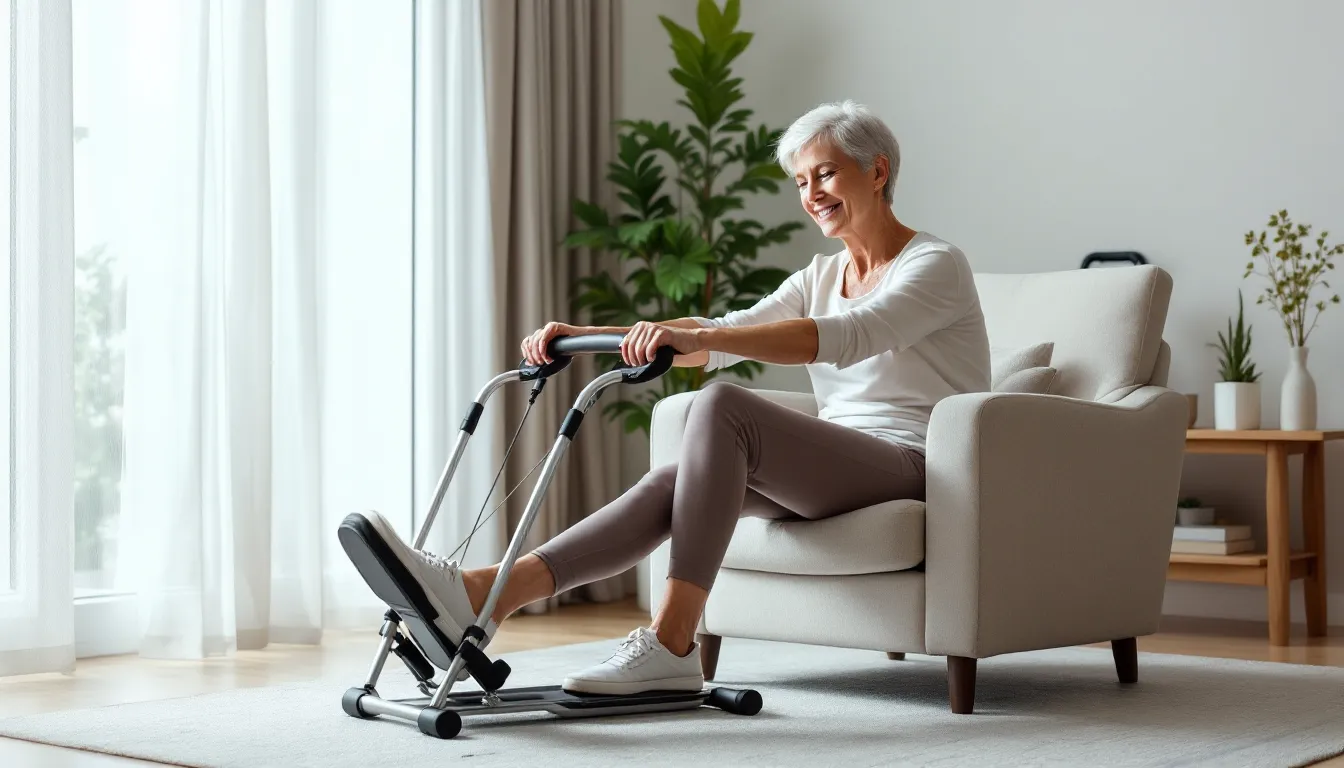
Seated Elliptical And Stepper Machines
Seated ellipticals and steppers are a step up (no pun intended) from basic pedal machines:
- Seated ellipticals
Your feet move in a gentle oval (elliptical) motion. This can feel smoother on the knees than a straight up-and-down pedal.
- Great for: joint-friendly motion, moderate cardio, and strength
- Often have: digital displays for time, distance, and resistance
- Mini steppers / seated steppers
Feet move up and down, mimicking stair-climbing while you’re seated.
- Great for: targeting thighs and glutes
- Good for: people who want more strength challenge without standing
These machines are often used in physical therapy and rehab because they let you control intensity and range of motion carefully.
Resistance Bands, Ankle Weights, And Simple Home Tools
You can also build strong, functional legs without any machine at all.
- Resistance bands
Light, stretchy bands you can loop around your ankles or thighs.
- Exercises: leg extensions, leg curls, side steps, seated marches
- Pros: very gentle on joints, very portable, easy to adjust resistance
- Ankle weights
Soft weights that strap around your ankles.
- Great for: increasing challenge during leg lifts or marches
- Best for: those who already have some strength and balance
- Simple home tools
- A sturdy chair for sit-to-stand exercises
- A step or low stair for step-ups
- A countertop or rail for supported balance practice
Together, these form a very effective “home gym” for senior leg strength, especially when combined with a leg exerciser like a pedal machine.
Who Can Benefit Most From A Leg Exerciser
A leg exerciser for seniors isn’t just for people in rehab. It’s helpful for almost anyone who wants to age more actively and confidently.
Ideal Scenarios: Post-Illness, Desk-Bound, Or Low-Mobility Seniors
You may benefit especially from a leg exerciser if you:
- Are recovering from illness, surgery, or a long hospital stay and need a gentle way to rebuild strength
- Spend many hours sitting, at a desk, in a recliner, or in front of the TV
- Feel unsteady walking but can sit safely in a chair
- Have mild to moderate joint pain that makes weight-bearing exercise uncomfortable
- Want to improve circulation in your legs but can’t stand or walk for long
In all of these cases, seated leg exercise offers a way to move safely without overloading your joints or balance.
When To Talk To A Doctor Or Physical Therapist First
Before starting any new exercise routine, it’s wise to check in with a healthcare provider, especially if you:
- Have heart disease, uncontrolled high blood pressure, or a history of stroke
- Recently had joint replacement, fractures, or major surgery
- Have severe arthritis or joint deformities
- Experience dizziness, fainting, or frequent falls
A doctor or physical therapist can:
- Help you choose the safest type of leg exerciser
- Suggest starting resistance levels and time limits
- Show you proper posture and technique
Red Flags And Contraindications To Watch For
Stop exercising and seek medical advice if you notice:
- Sharp or sudden pain in the knee, hip, ankle, or calf
- Chest pain, shortness of breath, or pressure that feels unusual
- Dizziness, lightheadedness, or blurred vision
- Severe swelling, redness, or warmth in one leg (could signal a blood clot)
Mild muscle fatigue or a gentle “burn” during exercise is normal. Sharp pain, intense breathlessness, or anything that feels alarming is not. When in doubt, it’s better to pause and ask than to push through.
How To Choose The Right Leg Exerciser For Your Needs
The “best” leg exerciser for seniors is the one you’ll actually use consistently and can operate safely.
Key Features: Stability, Adjustability, And Resistance Levels
Look for:
- Stable base
- Wide feet or a non-slip bottom so the device doesn’t slide on the floor.
- Some models include straps to secure the machine to a chair.
- Adjustable resistance
- Very light levels for warm-up and rehab
- Ability to gradually increase resistance as you get stronger
- Easy controls
- Simple knobs or buttons, clear display
- Large, easy-to-read numbers if vision is a concern
If your goal is strength as well as circulation, choose a model that lets you feel a noticeable (but manageable) push against your legs.
Comfort Considerations: Seat, Posture, And Joint Friendliness
Comfort is a major factor in whether you’ll stick with any exercise habit.
- Chair and seat height
- Make sure you can sit with your feet flat on the pedals, knees slightly bent.
- Avoid chairs that are too soft or low: a firm, stable chair is best.
- Posture support
- Your back should be supported and upright, not slumped.
- If needed, use a cushion or small pillow for lumbar support.
- Joint-friendly movement
- If you have knee or hip arthritis, an elliptical-style motion is often more comfortable.
- Check that the range of motion feels smooth and doesn’t force your joints into an uncomfortable angle.
Practical Factors: Size, Noise, Portability, And Budget
You’re more likely to use a leg exerciser that fits your space and lifestyle.
Consider:
- Size & storage
- Will it fit under a desk or coffee table?
- Can you easily slide it out of the way when not in use?
- Weight & portability
- Lighter models are easier to move, but heavier ones can feel more stable.
- Noise level
- Look for “whisper-quiet“ or low-noise options if you’ll use it while watching TV or if you live in an apartment.
- Budget
- Basic pedal exercisers can be very affordable.
- Mid-range seated ellipticals offer more features without being overly expensive.
Choose the simplest tool that meets your needs. More features aren’t helpful if they overwhelm you or never get used.
Setting Up A Safe And Effective Leg Exercise Routine
Once you’ve picked a leg exerciser for seniors, the next step is turning it into a simple, sustainable routine.
Getting Started: Warm-Up, Ideal Duration, And Intensity
Think of each session as having three parts:
- Warm-up (5 minutes)
- Start with very light resistance.
- Move slowly to gently wake up your joints and muscles.
- Main set (10–25 minutes)
- Choose a pace where you can still talk but feel like you’re doing some work.
- You might breathe a bit heavier, but you shouldn’t be gasping.
- Cool-down (3–5 minutes)
- Reduce the resistance and slow your pace.
- Finish with gentle ankle circles and calf stretches if safe for you.
Most beginners do well starting with 10–15 minutes, 3 days per week, then building from there.
Sample Beginner, Intermediate, And Advanced Routines
Use these as general templates. Always adjust based on how you feel and any medical guidance you’ve been given.
Beginner (first 2–4 weeks)
- Frequency: 3 days per week
- Warm-up: 5 minutes, very light resistance
- Main set: 8–10 minutes light resistance pedaling or stepping
- Cool-down: 3–5 minutes very light pedaling
Goal: Get comfortable with the movement and build a habit.
Intermediate
- Frequency: 4 days per week
- Warm-up: 5 minutes light resistance
- Main set: 15–20 minutes at medium resistance
- Option: Alternate 1 minute a bit faster, 2 minutes easy
- Cool-down: 5 minutes light pedaling
Goal: Improve strength, stamina, and circulation.
Advanced (with medical clearance)
- Frequency: 4–5 days per week
- Warm-up: 5 minutes
- Main set: 20–30 minutes at moderate resistance
- Option: Add short “power” bursts, 20–30 seconds of faster pedaling followed by 1–2 minutes easy
- Cool-down: 5 minutes
Goal: Maintain strength and power long term and support overall cardiovascular health.
Habit Stacking: Fitting Leg Exercise Into Daily Life
You don’t need a separate “gym time” for this to work. Try pairing your leg exerciser with things you already do:
- Pedal while watching your favorite 20-minute show
- Use your under-desk machine during morning emails
- Do 10 minutes after lunch to fight the after-meal slump
These small “micro sessions” add up and feel less intimidating than a formal workout.
Staying Safe: Form, Posture, And Listening To Your Body
A few safety guidelines go a long way:
- Sit tall with your chest lifted and shoulders relaxed, not hunched
- Keep your knees tracking in line with your toes, not collapsing inward or outward
- Start slower than you think you need to, especially if you haven’t exercised recently
- Increase only one variable at a time: time, speed, or resistance (not all three)
If something feels off, back down the intensity or stop for the day. Progress is about consistency, not pushing to the limit.
Beyond The Machine: Lifestyle Habits For Strong, Healthy Legs
A leg exerciser for seniors is a powerful tool, but your overall lifestyle still matters. Movement, food, rest, and mindset all work together.
Complementary Exercises: Walking, Balance, And Flexibility
When safe and approved by your doctor, consider adding:
- Walking
- Even 5–10 minutes at a time supports heart health and leg endurance.
- Balance drills (holding a counter or chair)
- Heel-to-toe standing
- Standing on one leg for a few seconds (with support nearby)
- Gentle flexibility work
- Calf stretches against a wall
- Seated hamstring stretch with a straight leg and tall spine
These exercises help your stronger legs translate into real-world stability and confidence.
Nutrition, Hydration, And Recovery For Leg Health
Strong muscles aren’t built by exercise alone. They also need:
- Adequate protein to repair and maintain muscle (talk to your doctor or dietitian, but many older adults benefit from spreading protein throughout the day)
- Hydration, especially if you’re taking medications that affect fluid balance
- Micronutrients that support bones, nerves, and muscles (like vitamin D, calcium, and magnesium), ideally from a balanced diet
- Rest days so your body can recover and adapt
Pay attention to how your legs feel the day after exercise. Mild soreness is normal: deep or worsening pain is a sign to scale back.
Mindset And Motivation For Long-Term Consistency
The biggest secret to better leg strength and circulation isn’t the perfect machine, it’s showing up regularly, even when you’re not feeling 100% motivated.
A few mindset shifts can help:
- Focus on function, not just fitness: getting out of a chair easily, walking with grandkids, traveling without fear of falling.
- Celebrate small wins: 3 sessions this week, 5 more minutes than last time, less stiffness in the morning.
- See setbacks as pauses, not failures: illness, travel, or busy weeks happen. You can always restart gently.
Every time you use your leg exerciser, you’re casting a vote for a stronger, more independent future self. That’s worth showing up for, even in small doses.