
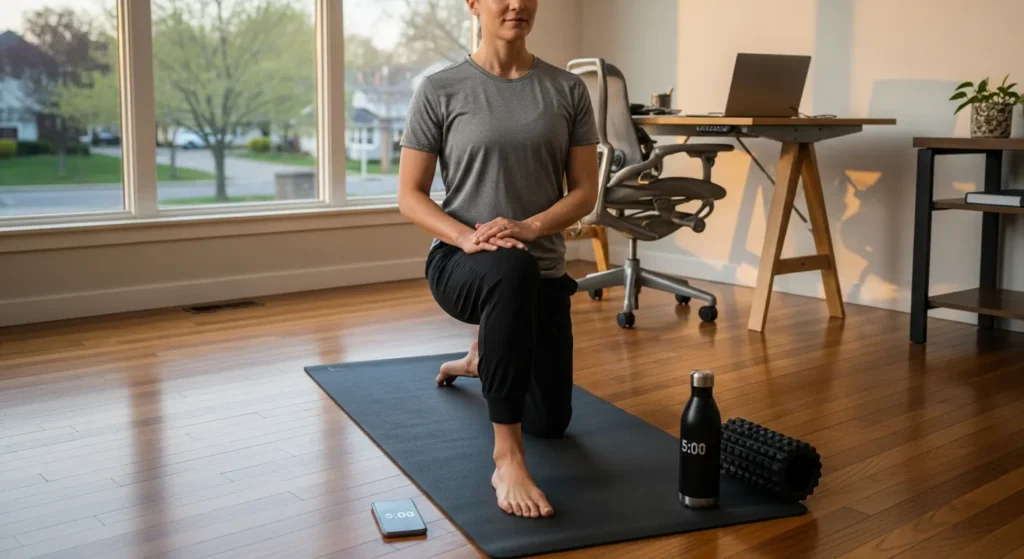
If you’ve ever stood up from your desk and felt like your hips aged 20 years during that meeting… yeah, you’re not alone.
Flexibility training sounds simple (“just stretch.”), but most people either do random stretches for 30 seconds and quit, or they push so hard they end up sore, annoyed, and convinced they’re “not a flexible person.” The good news: getting more flexible is way less about genetics than people think, and way more about using the right method, at the right time, with just enough consistency.
This guide will walk you through what flexibility training actually is, what the science says about improving range of motion, and how to build a tiny routine you’ll actually stick with, even on busy weeks.
What Flexibility Training Is (And What It Is Not)
Flexibility training is the practice of improving your range of motion (ROM), how far a joint can move comfortably, by using structured stretching and related methods.
In plain English: it helps your muscles and connective tissue allow more motion so you can move fully and pain-free.
But flexibility training is not:
- A contest to see how far you can crank a joint.
- The same thing as being “double-jointed” (hypermobility).
- A substitute for strength training.
Flexibility Vs. Mobility Vs. Stability
These terms get mixed up constantly, so here’s the clean breakdown:
- Flexibility = how much your muscles/tissues can lengthen to allow ROM.
- Mobility = flexibility plus your ability to control that ROM (strength + coordination).
- Stability = your ability to own positions, especially near end range, so your joints feel safe and solid.
If you want movement that feels good long-term, you usually don’t want “more flexibility” by itself. You want usable range, range you can control.
Why “Stretching More” Often Doesn’t Work
Most stretching fails for three boring (but fixable) reasons:
- Not enough total time under tension: Your body adapts slowly. A few quick reaches once in a while won’t move the needle.
- Wrong timing: Stretching cold tissues tends to feel awful and can make you guard even more.
- Too intense: If you chase pain, your nervous system interprets it as a threat and tightens up, basically the opposite of what you want.
Also, a lot of people stretch the same tight spots forever (hello hamstrings) while ignoring the actual drivers, often hips, upper back (T-spine), and ankles.
The Real Benefits Of Flexibility For Health, Performance, And Longevity
Flexibility training isn’t just about touching your toes or doing a clean yoga pose for Instagram. When it’s done well, it changes how you move all day, walking, lifting, running, sleeping, even just sitting without feeling “stuck.”
Research and expert consensus generally support flexibility work for improving ROM, movement efficiency, and comfort. Some studies also suggest stretching may support cardiovascular markers like arterial stiffness and blood pressure in certain populations, especially when it’s consistent and part of an overall healthy routine.
Joint Health, Pain Reduction, And Daily Movement Quality
Better flexibility can improve functional ROM, the kind you actually use in life:
- Squatting to pick something up without your low back complaining
- Reaching overhead without shoulder pinching
- Turning your head while driving without feeling like a robot
In people with joint issues like osteoarthritis, appropriately scaled stretching and mobility work can reduce stiffness and support daily function. It’s not a cure-all, but it can make your body feel more “lubricated” and capable.
Strength Training Synergy, Recovery, And Injury Risk
Flexibility training works best when it’s paired with strength training:
- Strength gives you control.
- Flexibility gives you access.
Together, you can often lift with better positions (think: deeper squat with a neutral spine, stronger overhead press without arching your back). That usually means better training quality and, for many people, fewer annoying tweaks.
A quick note on injury risk: stretching alone isn’t magical armor. But having adequate ROM for your sport and building strength through that ROM can reduce strain in the “usual suspects” tissues.
And yes, post-workout stretching can help some people feel less tight afterward and may support recovery, especially when it’s gentle and consistent.
Stress, Nervous System Downshifting, And Sleep Support
Here’s the underrated part: flexibility training can be a nervous system practice, not just a body practice.
Slow stretching with calm breathing can shift you toward a parasympathetic (“rest and digest”) state. Some research links stretching routines with improvements in relaxation markers like heart rate variability and reductions in blood pressure.
If your brain runs hot all day, a 5–10 minute evening stretch can be a surprisingly effective “off-ramp” into sleep. Not perfect every time, but helpful more often than not.
The Science Of Getting More Flexible
Flexibility gains aren’t mystical. They’re mostly about two things:
- Your tissues adapting to repeated loading at longer lengths.
- Your nervous system allowing you to go there without hitting the brakes.
Tissue Adaptation, Stretch Tolerance, And Time Under Tension
When you stretch, you’re doing a low-level form of training. Over time, your body may add sarcomeres in series (a muscle adaptation), remodel connective tissue, and, very importantly, improve stretch tolerance (your comfort in that position).
One big driver is time under tension. Reviews suggest a dose-response relationship: more total stretching time (up to a point) tends to produce bigger ROM gains. In some data, 60 minutes per day outperforms 30 minutes per day, and both generally beat very small doses.
That said, you don’t need an hour a day to benefit. You just need enough consistency to signal, “Hey, we use this range now.”
Why Breathing And Relaxation Change Range Of Motion
Ever notice how you can sink deeper into a stretch after a few slow exhales?
That’s not in your head, it’s your nervous system changing its threat assessment.
- Slow nasal breathing and long exhales can reduce protective muscle tone.
- Relaxation lowers the reflexive “guarding” that limits ROM.
A simple cue that works: inhale gently, exhale longer than you inhale, and let the exhale be your “permission slip” to soften.
How Often, How Long, And How Hard To Stretch
If you want a simple evidence-based starting point:
- Frequency: 3–7 days per week
- Time: 10–60 minutes per day total (split up if needed)
- Intensity: mild-to-moderate discomfort, not pain
For most busy people, the sweet spot is:
- 5 minutes daily (to maintain and feel better)
- plus 2–4 slightly longer sessions per week (to actually change ROM)
Progress comes from calm repetition, not heroic sessions followed by two weeks of nothing.
The Main Types Of Flexibility Training And When To Use Each
Not all stretching is the same. The “best” type depends on what you’re doing next: lifting, running, recovering, or winding down.
Static Stretching
This is the classic hold-and-breathe style.
How to use it:
- Hold 30–60 seconds
- 1–3 rounds per muscle group
- Best after workouts or in a separate session
Static stretching can improve ROM and feels great for downshifting. Just avoid long static holds right before heavy power work if you’re trying to be explosive (a short, gentle hold is usually fine: long intense holds can temporarily reduce peak output).
Dynamic Stretching And Mobility Drills
This is controlled movement through range, leg swings, lunges with rotation, cat-cow variations, hip airplanes (scaled), etc.
How to use it:
- 5–10 minutes as part of your warm-up
- Keep it smooth, not aggressive
Dynamic work is money before training because it raises tissue temperature, rehearses movement patterns, and tells your nervous system, “We’re about to move.”
PNF And Isometrics (Contract-Relax Methods)
PNF (proprioceptive neuromuscular facilitation) and isometrics involve contracting a muscle, then relaxing into a deeper range.
Why it works: it can improve both ROM and end-range strength/control.
A simple contract-relax approach:
- Move into a mild stretch.
- Gently contract (about 20–50% effort) for 5–10 seconds.
- Relax, exhale, and ease a little deeper.
- Repeat 2–3 times.
This is great when you’ve plateaued with basic stretching, or when you want flexibility that transfers to real movement.
Ballistic Stretching: Who Should Avoid It
Ballistic stretching uses bouncing or momentum to push deeper.
For most people, especially if you sit a lot, have a history of strains, or don’t train movement skills regularly, ballistic work is a skip. It can increase injury risk if you don’t have the tissue capacity and control.
If you’re an experienced athlete in a sport that requires it (certain martial arts, gymnastics, dance), it can be appropriate under coaching. Otherwise, you can get 95% of the benefits with safer methods.
Build Your Weekly Flexibility Plan Around Your Goal
Flexibility training works best when it matches your real life. Your body doesn’t care about your intentions: it adapts to what you repeatedly do.
So let’s make it specific.
For Desk Stiffness And Daily Comfort
Your goal is less “become a contortionist” and more “stop feeling like a folded laptop.”
Try:
- 5 minutes daily focused on the biggest office culprits: neck, T-spine, hips, ankles
- Micro-breaks: 30–60 seconds of movement every 60–90 minutes (even standing and reaching helps)
Prioritize hip flexors, chest, and upper back rotation. Desk life tends to shorten the front of your body and stiffen the mid-back.
For Strength Athletes And Gym Performance
You want ROM that improves lifting positions and keeps your joints happy.
Try:
- Dynamic mobility before training (5–8 minutes)
- Post-workout: 10–15 minutes of static stretching for the muscles you hammered
- 1 weekly session to target your limiting factors (often ankles/hips for squats, T-spine/shoulders for pressing)
Pro tip: if you can’t control end range, build it. Pair stretching with slow eccentrics, pauses, or isometric holds in the new range.
For Runners And Endurance Training
Runners don’t always need extreme flexibility, but they do need enough ROM to maintain stride mechanics and reduce repetitive stress.
Try:
- 2–4x/week: calves, hip flexors, hamstrings, glutes
- Add ankle mobility and hip extension work (often overlooked)
Keep it gentle on hard training weeks. The goal is to stay springy, not floppy.
For Active Aging And Long-Term Joint Capacity
If you’re thinking long game, lifting groceries at 70, traveling comfortably, getting up from the floor without drama, flexibility training is a quiet superpower.
Try:
- Daily light mobility (5 minutes)
- One 30-minute session weekly for deeper work
- Combine with strength training 2–3x/week to keep that new range usable
Consistency matters more than intensity here. The win is steady capacity, not pushing limits.
A Time-Efficient Routine You Can Actually Stick With
You don’t need a perfect plan. You need a plan that survives a normal week.
Below are three options that stack nicely together. If you only do one, start with the 5-minute reset.
The 5-Minute Daily Reset (Neck, T-Spine, Hips, Ankles)
Set a timer. Move slowly. Breathe.
- Neck reset (45 seconds/side)
- Gentle upper trap stretch or ear-to-shoulder with long exhales.
- T-spine opener (60 seconds)
- Open-book rotations on the floor or thread-the-needle.
- Hip flexor stretch (60 seconds/side)
- Half-kneeling hip flexor, glute lightly engaged.
- Ankle dorsiflexion drill (30–45 seconds/side)
- Knee-to-wall rocks, controlled.
That’s it. You’ll feel different immediately, not because you “fixed” anything, but because you reminded your nervous system that movement is safe.
The 15-Minute Post-Workout Flexibility Session
Do this after lifting or cardio, when tissues are warm.
- Quads/hip flexors: 2 x 45–60s/side
- Hamstrings: 2 x 45–60s/side
- Glutes/piriformis: 2 x 45–60s/side
- Chest/pecs: 2 x 45–60s/side
- Calves: 2 x 45–60s/side
Optional upgrade: add 1–2 rounds of contract-relax on the tightest area.
The 30-Minute Weekly Deep-Dive Session
This is your “make real changes” session. Put it on your calendar like a meeting.
Structure:
- 5 minutes easy warm-up (walk, bike, light dynamic moves)
- 20 minutes focused stretching (pick 3–4 areas, spend time)
- 5 minutes downshift breathing (especially if stress is high)
If you want a simple format: 3 areas x (3 rounds x 60 seconds) + breathing.
The key is calm, steady holds with long exhales. Treat it like skill practice, not a fight.
Common Mistakes And How To Fix Them
Most flexibility frustration comes from a handful of common errors. Fix these, and progress usually shows up fast (like, within a few weeks).
Stretching Cold, Rushing Holds, And Chasing Pain
Mistake: Dropping into deep stretches first thing in the morning or after sitting all day, then bouncing or forcing.
Fix:
- Warm up 2–5 minutes (walk around, do gentle mobility)
- Hold 30–60 seconds minimum for static work
- Aim for 3–5/10 discomfort, not 9/10 pain
Pain makes you guard. Guarding kills range.
Ignoring Strength At End Range
Mistake: You gain ROM, but it feels unstable, or it disappears quickly.
Fix: Add strength where you’re trying to get flexible.
Examples:
- Split squats with a pause at the bottom (hips)
- Slow calf raises through full range (ankles)
- Controlled Jefferson curls only if appropriate and pain-free (hamstrings/spine, many people should skip or modify)
If you can’t control it, your body won’t keep it.
Skipping The “Big Three” Tight Spots: Hips, T-Spine, Ankles
Mistake: Stretching what feels tight (often hamstrings) while ignoring what’s actually limiting your movement.
Fix: Make the big three non-negotiable:
- Hips (especially hip flexors and external rotators)
- T-spine (rotation/extension for posture and shoulders)
- Ankles (dorsiflexion for squats, stairs, running mechanics)
Even 5 minutes a day here can change how your whole body moves.
How To Track Progress And Stay Safe
Flexibility is sneaky: you might feel better in daily life but not notice “measurable” progress. Tracking keeps you honest, and keeps you from overdoing it.
Simple Range-Of-Motion Benchmarks And Photos
Pick 2–3 benchmarks and re-test every 2–4 weeks.
Ideas:
- Toe-touch: Can your fingertips reach your toes comfortably?
- Knee-to-wall ankle test: How far can your toes be from the wall while your knee still touches without heel lift?
- Overhead reach: Can you get arms overhead without rib flare or low-back arch?
Take quick photos from the side/front under similar conditions (same time of day helps). Small changes add up.
When To Modify Or Stop (Red Flags And Medical Considerations)
Stop and reassess if you feel:
- Sharp, stabbing pain
- Numbness, tingling, burning sensations
- Joint “catching,” giving way, or instability
- Pain that lingers or worsens after sessions
Also be cautious if you have hypermobility, recent surgery, acute injury, or known joint conditions. In these cases, the emphasis often shifts toward stability and controlled strength, not just more range.
When To Get Help From A Physical Therapist Or Coach
Get support if:
- You’ve had pain for more than 2–4 weeks even though smart modifications
- One side is dramatically stiffer/weaker and it’s affecting training or walking
- You’re unsure whether a sensation is “normal stretch” vs. a nerve/joint issue
A good physical therapist or qualified coach can spot movement compensation patterns you can’t see yourself, and give you the fastest path to safe progress.
Conclusion
Flexibility training doesn’t have to be a big production. You don’t need a yoga studio membership, a 45-minute routine, or a personality transplant.
What you do need is a tiny, repeatable plan: a few minutes most days, a slightly longer session a couple times a week, and a focus on calm breathing and control, not pain.
If you want the simplest next step, do this tonight: set a 5-minute timer, hit your hips, T-spine, and ankles, and breathe like you mean it. Then do it again tomorrow.
That’s how flexibility actually happens, quietly, consistently, and in a way that makes your body feel like a nicer place to live.