If you’ve ever stood up from your desk, tried to stretch, and thought, “Wow… when did my body get this stiff?”, you’re not alone.
Most flexibility advice online is either too intense (hello, painful yoga poses) or too vague (“just stretch more”). The good news: you don’t need to be naturally bendy, and you don’t need an hour a day.
In this guide, you’ll learn what flexibility actually is, how to stretch safely, and two beginner-friendly routines (10 minutes daily or 20 minutes, three times per week). It’s science-backed, realistic for busy adults, and designed to make you feel looser, calmer, and more capable, without turning stretching into yet another “project.”
.Person stretching hamstrings on a yoga mat in a bright living room (stock photo)
What Flexibility Really Means (And Why It Matters For Busy Adults)
Flexibility is your muscles’ ability to lengthen safely so your joints can move through a comfortable range of motion. In real life, that means things like:
- Getting out of the car without your hips feeling like rusty hinges
- Reaching overhead without your neck doing all the work
- Squatting down to grab something without your lower back complaining
If you sit a lot (and most of us do), your body adapts to that position. Hip flexors tighten, upper back gets stiff, and your nervous system starts treating “full range of motion” like it’s suspicious. Flexibility work is basically you reminding your body: this is safe, we can go here.
Flexibility Vs Mobility Vs Stability
These three get mixed up constantly, so here’s the clean version:
- Flexibility = muscle length (can the muscle/tendon tolerate a longer position?).
- Mobility = usable range of motion at a joint with control (can you move there smoothly and own it?).
- Stability = ability to maintain position under load or stress (can you resist unwanted movement?).
Why this matters as a beginner: flexibility is a great “entry point.” It’s simple, low-impact, and it supports mobility and stability over time.
Key Benefits: Posture, Pain Reduction, Performance, And Stress Relief
A consistent flexibility routine can pay off in a bunch of ways, especially if you’re a busy adult who wants results without drama.
- Better posture (without “trying” to sit straight): When your chest, hip flexors, and calves are tight, your posture often compensates. Loosening common tight areas makes neutral posture easier to access.
- Less everyday aches: Tight hips and hamstrings often contribute to lower-back irritation: tight chest and neck muscles can feed tension headaches. Stretching doesn’t fix everything, but it can reduce the “background noise.”
- Better performance and movement quality: Whether you lift weights, run, cycle, or just want to move well, range of motion helps you train (and live) with less compensation.
- Stress relief: Slow stretching paired with calm breathing nudges your nervous system toward a more relaxed state. Many people notice they sleep better or feel less “wired” after a short evening session.
If you’re looking for the highest return on time invested, flexibility work is sneaky-good, because it improves how your body feels in the hours between workouts, not just during them.
How To Stretch Safely As A Beginner
Stretching should feel like a friendly negotiation, not a fight.
The safest beginner approach is mostly static stretching (holding a position) and gentle active movements to warm up. Research and expert consensus generally support stretching as safe and effective when it’s done after light activity, held at tolerable intensity, and progressed gradually.
When To Stretch: Warm-Up, Cooldown, And Rest Days
Timing matters more than people think.
- Best option: Stretch after you’ve warmed up (even 5–10 minutes of walking counts). Warm tissue tends to tolerate stretch better.
- After workouts (cooldown): Great time for longer holds because your body is already warm.
- On rest days: Totally fine, and often when you’ll feel the biggest relief.
- Try not to: Do deep stretching when you’re cold, first thing out of bed, or right after sitting for hours without moving first.
A simple rule: if your body feels like cold taffy, do 2–5 minutes of easy movement before you stretch.
Intensity Cues: Mild Tension, Not Pain
Stretching should feel like mild to moderate tension, not sharp, not burning, not “please make it stop.”
Use this quick scale:
- 0–3/10: Too easy (you’ll get minimal change)
- 4–6/10: Ideal for most beginners (noticeable tension, steady breathing)
- 7–10/10: Too intense (your body guards, you compensate, you risk strain)
And watch for sneaky compensation:
- Holding your breath
- Clenching your jaw
- Shrugging your shoulders
- Twisting to “fake” the range of motion
If that’s happening, back off a little. You’ll progress faster, not slower.
Breathing And Nervous System Basics For Better Range Of Motion
Here’s the underrated truth: flexibility isn’t only about muscles, it’s also about your nervous system.
Your brain is constantly asking: Is this range safe? If the answer is “not sure,” your body tightens up to protect you.
Breathing helps change that signal.
Try this during holds:
- Inhale through your nose for ~4 seconds
- Exhale slowly for ~6 seconds
- On the exhale, relax your face, shoulders, and belly
Longer exhales are a simple way to shift toward a calmer, “rest-and-digest” state, which often lets you access a little more range, without forcing it.
One more tip: aim for 5–30 second holds, repeated 2–6 times per side, depending on time and tolerance. Consistency beats marathon sessions every time.
Beginner-Friendly Flexibility Exercises (Full-Body)
Below are beginner-friendly flexibility exercises that hit the usual “tight from life” zones: neck/upper body, hips/glutes, and the entire back-of-legs chain.
Pick 1–2 from each group, or use them all in the routines later.
Neck, Chest, And Upper Back Stretches
1) Seated upper trapezius stretch (neck side-bend)
- Sit tall (or stand) and relax your shoulders
- Gently tilt your right ear toward your right shoulder
- Keep your chin slightly tucked (don’t look up)
- Option: place your right hand lightly on the side of your head for gentle added pressure
Hold: 15–30 seconds per side, 2 rounds
2) Wall chest stretch (pec stretch)
- Stand next to a wall
- Place your forearm on the wall, elbow roughly shoulder height
- Step forward and slightly rotate your body away until you feel the stretch across your chest/front shoulder
Hold: 20–30 seconds per side, 2 rounds
3) Thread-the-needle (upper back + rear shoulder)
- Start on hands and knees
- Slide your right arm under your left arm, letting your right shoulder and side of head rest on the floor (or a pillow)
- Keep hips stacked above knees if possible
Hold: 20–30 seconds per side
Hips And Glutes Stretches
1) Reclining figure-4 stretch (glutes/piriformis)
- Lie on your back, knees bent
- Cross right ankle over left knee
- Thread hands behind the left thigh and gently pull toward your chest
- Keep your head and shoulders relaxed
Hold: 20–40 seconds per side
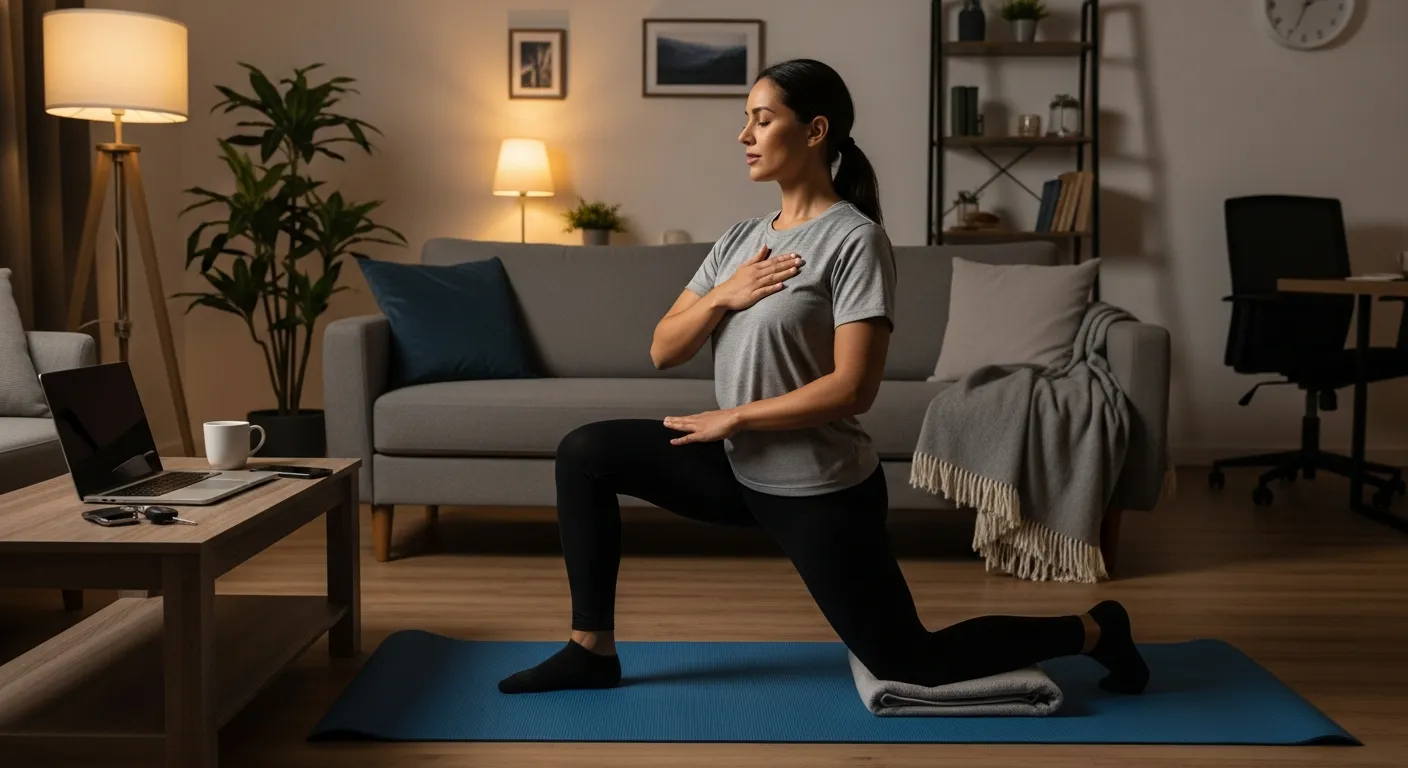
2) Half-kneeling hip flexor stretch (front of hip)
- Kneel on your left knee, right foot in front (like a lunge)
- Tuck your pelvis slightly (think “zipper up”)
- Gently shift forward until you feel the stretch in the front of the left hip
- Option: raise the left arm overhead for a deeper line of stretch
Hold: 20–30 seconds per side
3) 90/90 hip stretch (external + internal rotation)
- Sit with your front leg bent at ~90 degrees and back leg bent at ~90 degrees
- Keep chest tall: lean forward slightly over the front shin
Hold: 20–30 seconds per side
Hamstrings, Calves, And Ankles Stretches
1) Seated hamstring stretch (head-to-knee style)
- Sit with one leg straight, the other bent comfortably
- Hinge forward from your hips (think: long spine)
- Reach toward your shin/ankle/foot, wherever you can without rounding hard
Hold: 20–30 seconds per side
2) Wall calf stretch
- Hands on wall, one leg back
- Keep back heel down and back knee straight (targets gastrocnemius)
- Then bend the back knee slightly (targets soleus)
Hold: 20 seconds each version per side
3) Supported forward fold (hamstrings + back line)
- Stand with feet hip-width
- Soft bend in knees
- Hinge at hips and let your upper body hang
- Rest hands on thighs/shins or a chair seat
Hold: 20–40 seconds
If any of these feel “impossible,” that’s not a sign you’re broken. It’s just your starting point. We’ll scale them next.
A 10-Minute Daily Flexibility Routine (No Equipment)
This is the routine you do when life is busy and you still want to feel good in your body. Ten minutes is short enough that you won’t dread it, but long enough to create real change over a few weeks.
Simple Timing: Holds, Sets, And Rest
Use this simple structure:
- Hold each stretch: 20–30 seconds
- Sets: 2 rounds per stretch
- Rest: 10–20 seconds between sides or moves
Do it once daily (even 5 days/week is great).
10-minute sequence:
- Upper trap neck stretch – 20–30s/side, 2 rounds
- Wall chest stretch – 20–30s/side, 2 rounds
- Half-kneeling hip flexor stretch – 20–30s/side, 2 rounds
- Reclining figure-4 stretch – 20–40s/side, 1–2 rounds
- Wall calf stretch (straight-knee) – 20s/side, 2 rounds
If you have an extra minute, add a supported forward fold for 30 seconds at the end.
How To Scale Each Stretch If You’re Tight Or Desk-Bound
If you sit a lot, your body might resist at first, especially hips, calves, and chest. Scaling keeps it safe and effective.
- Neck stretch: Don’t pull your head. Just tilt and breathe. If you feel tingling down your arm, stop and choose a gentler angle.
- Chest stretch: Lower your elbow height if your shoulder feels pinchy.
- Hip flexor stretch: Use a cushion under the knee. Keep the pelvis tucked, most people skip this and dump into the lower back.
- Figure-4: If threading the hands is tough, hug the back of the thigh with a towel.
- Calf stretch: Step a little closer to the wall to reduce intensity: keep heel down.
And a small habit upgrade: pair this routine with something you already do. After brushing your teeth at night. After your shower. While your coffee brews. The best flexibility routine is the one that quietly becomes automatic.
A 20-Minute 3x/Week Routine For Faster Progress
If you want faster progress (without needing daily sessions), this 20-minute routine gives you more total volume and more joint variety.
Aim for 3 days/week (like Mon/Wed/Fri). If you also strength train, this works beautifully after workouts.
Add Light Mobility Flows Without Turning It Into A Workout
Mobility flows are gentle, controlled movements that teach your body to use the range you’re building.
Here’s a simple 4-minute warm-up flow (easy pace):
- Shoulder rolls: 5 slow circles each direction
- Cat-cow: 6–8 reps
- World’s simplest hip circles (standing): 5 each direction per side
- Ankle rocks (knee over toes, heel down): 8 reps per side
That’s it. You’re warm, your joints feel “online,” and you haven’t broken a sweat.
Pairing With Strength Training Or Cardio For Better Results
A practical schedule that works for real people:
- After strength training: Do your longer holds. Your muscles are warm and more receptive.
- After cardio (walk, run, cycling): Great for calves, hips, hamstrings.
- On non-training days: Keep it gentle and relaxing, think “recovery,” not “grind.”
20-minute routine (3x/week):
- Mobility warm-up flow (above) – ~4 minutes
- Wall chest stretch – 30s/side, 2 rounds
- Thread-the-needle – 30s/side, 1–2 rounds
- Half-kneeling hip flexor stretch – 30s/side, 2 rounds
- 90/90 hip stretch – 30s/side, 1–2 rounds
- Seated hamstring stretch – 30s/side, 2 rounds
- Calf stretch (straight-knee + bent-knee) – 20s each/side
If you want one “bonus” move for desk posture, add 30 seconds of supported forward fold at the end.
A quick expectation reset: you’ll often feel immediate relief after session one, but measurable flexibility changes typically show up over weeks. That’s normal, and honestly, it’s a good sign you’re doing it sustainably.
Common Mistakes That Stall Flexibility Progress
Most flexibility plateaus aren’t because you “just have tight hamstrings.” They happen because the method is fighting your body instead of working with it.
Stretching Cold, Bouncing, And Overdoing It
Three classics:
- Stretching cold: You’re more likely to strain something and less likely to get good range. Do a short warm-up.
- Bouncing (ballistic stretching): Beginners often bounce to “go deeper,” but it can trigger a protective reflex and irritate tissue.
- Overdoing it: Long, aggressive holds can leave you feeling sore and guarded, so you stretch less the next day. Progress slows.
If you want a simple safety rule: smooth entry into the stretch, calm breathing, steady hold.
Why Consistency Beats “Deep” Stretching
Deep stretching feels productive… until it doesn’t.
Your body changes with repeated exposure more than occasional intensity. Five to ten minutes most days (or 20 minutes three times/week) tends to beat a heroic 60-minute session once every two weeks.
Try thinking of flexibility like brushing your teeth:
- It’s not about doing it hard.
- It’s about doing it often enough that the benefits stack quietly.
If you want to “go deeper,” earn it with time. Let your nervous system trust the positions first, then the range will follow.
Tracking Progress And Building The Habit
Flexibility is tricky to measure because day-to-day results depend on sleep, stress, training, hydration, and even how long you’ve been sitting.
So instead of obsessing over millimeters, track progress in a way that keeps you motivated.
Quick Benchmarks To Measure Change Without Overthinking
Pick one or two benchmarks and check them weekly (not daily):
- Toe touch test: How far can your fingers reach comfortably with soft knees?
- Hip flexor feel: Does standing tall feel easier after long sitting?
- Shoulder reach: Can you reach overhead without rib flare or neck tension?
- Comfort markers: Less stiffness in the morning? Fewer “twinges” during the day?
A simple trick that works: take a quick photo or note once a week. Same time of day, same warm-up. You’ll spot progress you’d otherwise miss.
Micro-Routines: The Easiest Way To Stay Consistent
If you struggle with consistency, go smaller, not bigger.
Try “micro-routines” that take 60–120 seconds:
- Desk reset (1 minute): wall chest stretch 30s/side
- Hip reset (2 minutes): half-kneeling hip flexor 30s/side, then figure-4 30s/side
- Calf/ankle reset (1 minute): calf stretch 30s/side
These are also great on days when you don’t do the full routine, because they keep the habit alive.
And yes, putting it on your calendar helps. Treat it like a meeting with Future You, who would like to keep moving without random pains, thanks.
Conclusion
If flexibility exercises for beginners have felt intimidating, or like something you’ll “get to someday”, you can drop that story now. You don’t need extreme stretches or perfect form. You need a small, repeatable routine that your body learns to trust.
Start with the 10-minute daily plan if you want simplicity and a calmer body day-to-day. Choose the 20-minute, 3x/week routine if you like structured sessions and quicker progress. Either way, keep the intensity at mild-to-moderate tension, breathe like you mean it, and focus on consistency.
Your body isn’t stubborn. It’s protective. Show it, gently and repeatedly, that movement is safe, and you’ll be surprised how quickly “stiff” stops feeling like your default.
.Minimal line-art style image of a person doing a seated hamstring stretch (AI-generated)