

Key takeaways:
- You can use HSA funds for most medically necessary dental expenses (not cosmetic) for you, your spouse, and dependents.
- Keep itemized receipts and any letter of medical necessity, these protect you if the IRS ever asks.
- HSAs pair well with limited-purpose FSAs and roll over year to year, making them powerful for big dental work.
- Time major procedures with annual HSA contributions and get pre-treatment estimates to avoid surprises.
You’ve probably heard HSAs are great for saving on healthcare, but the gray area is dental care, especially things like orthodontics, implants, or TMJ treatment. The short answer: yes, you can use a Health Savings Account for dental, as long as the expense is considered medically necessary by IRS rules (see Publication 502). Below, you’ll find a simple, evidence-based guide to what counts, what doesn’t, and smart ways to pay so you keep more money in your pocket (and in your smile).
What An HSA Covers For Dental Care

Preventive, Basic, And Major Services
Most routine dental care is HSA-eligible when it’s for diagnosis, prevention, or treatment of a dental disease. That includes:
- Exams and cleanings (prophylaxis)
- X-rays and sealants
- Fillings, extractions, periodontal (gum) therapy
- Root canals and other endodontic treatments
Why? The IRS defines qualified medical expenses as those that primarily alleviate or prevent a physical or dental defect or illness. Preventive and restorative dental services clearly fit. If you’re wondering, “Are fillings HSA-eligible?“, yes. “Are root canals HSA-eligible?“, also yes.
Orthodontics And Aligners
Braces and clear aligners can be HSA-eligible if your dentist or orthodontist documents a medical need, crowding that impairs function, bite problems causing jaw pain or abnormal wear, or airway considerations, for example. A letter of medical necessity (LMN) from your provider strengthens your file if you ever need to substantiate the expense. Cosmetic-only straightening (purely for looks) isn’t eligible, more on that below.
Practical tip: If you’re doing a two-year orthodontic plan, you can often pay in installments and use HSA funds as you go, aligning payments with each year’s HSA contributions.
Implants, Crowns, And Dentures
Implants, crowns, bridges, and dentures are typically HSA-eligible when they restore chewing function, replace missing teeth after disease or injury, or address documented dental pathology. If you’ve asked, “Are dental implants HSA-eligible?“, yes, assuming the purpose is restoration, not cosmetic enhancement. Keep the treatment plan, invoice, and your dentist’s notes, and request an LMN if the medical need isn’t obvious from the paperwork.
TMJ And Medically Necessary Oral Surgery
Treatment for temporomandibular joint (TMJ) disorders, such as bite splints, physical therapy ordered by a dentist or physician, or surgical procedures, can be HSA-eligible when prescribed for pain, dysfunction, or joint pathology. Likewise, wisdom tooth removal, biopsies, and other medically necessary oral surgeries qualify. Again, documentation matters. Save the referral, op notes, and receipts.
Dental Expenses That Are Not HSA-Eligible
Cosmetic Procedures And Aesthetic Veneers
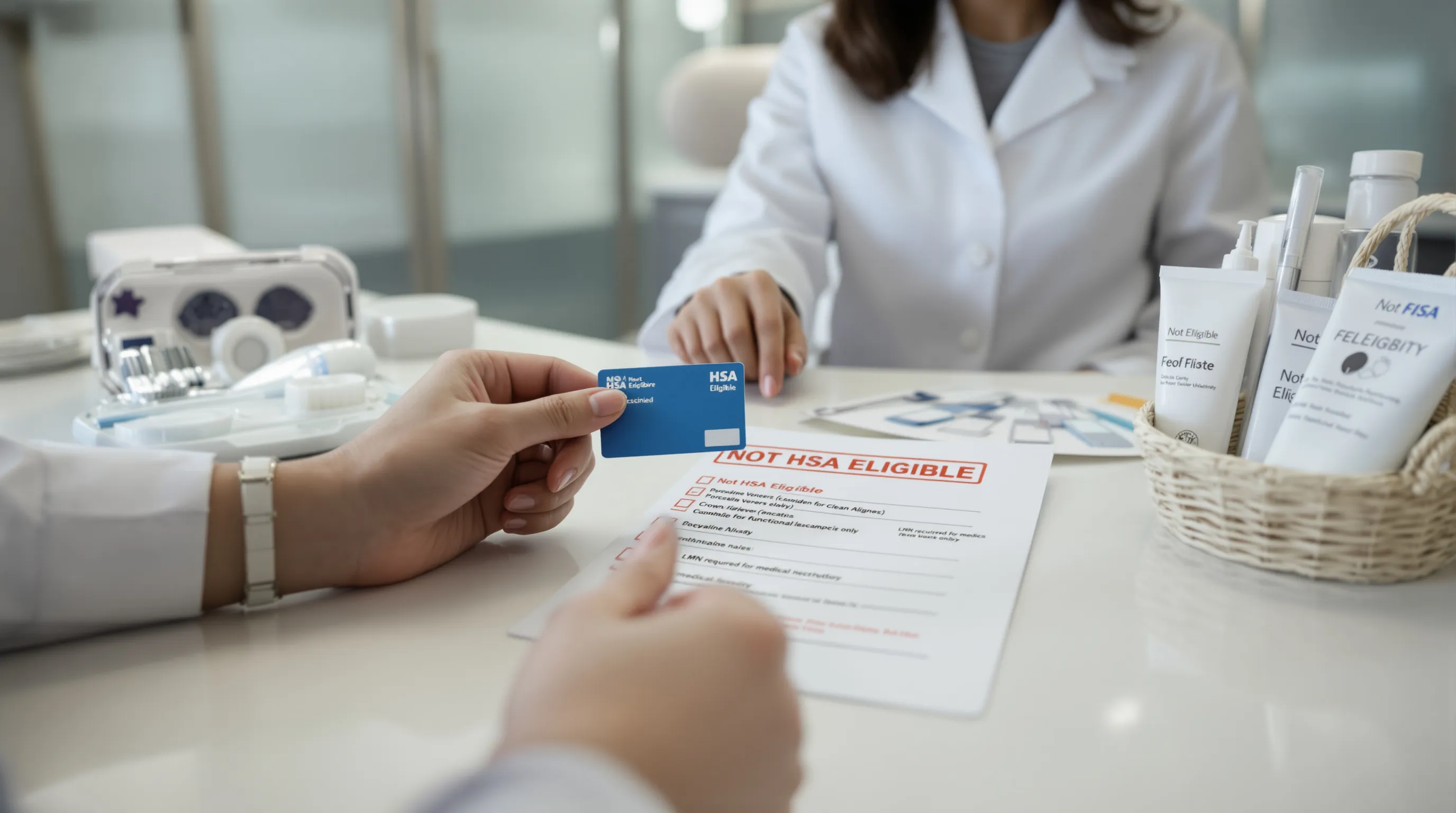
Cosmetic dentistry, purely aesthetic veneers, teeth whitening, bonding for appearance only, is generally not HSA-eligible. If veneers or crowns are part of functional reconstruction after trauma or decay, that can be different. In those cases, ask your dentist for a letter of medical necessity and keep the before/after clinical notes.
Cosmetic Orthodontics Without Medical Necessity
If aligners or braces are sought exclusively to improve appearance, without documented bite issues or functional problems, they’re not eligible. When in doubt, have your orthodontist write an LMN that clearly states the medical rationale.
Membership Plans, Hygiene Products, And Fees
Dental discount plan fees, office membership programs, toothbrushes, toothpaste, floss, mouthwash, and general health products aren’t HSA-eligible. Neither are missed appointment fees or concierge fees. HSA funds are intended for care, not convenience or general wellness items.
How To Pay For Dental With An HSA
Paying The Dentist Directly With Your HSA Card
The simplest route is to use your HSA debit card at checkout for eligible expenses. Ask for an itemized receipt (with CDT codes) and keep it with your records. If your dentist runs estimates before insurance adjudication, you may pay a portion up front and a balance after claims process, both can be HSA-eligible.
Reimbursing Yourself Later And Saving Receipts
Prefer cash-back flexibility? Pay out of pocket, then reimburse yourself from your HSA once you have the final explanation of benefits (EOB). There’s no deadline in the tax code for when you must reimburse yourself, as long as the expense occurred after your HSA was established, so you can let funds grow, then pull cash later. Save the dated receipt, EOB, and any LMN.
Coordinating With Dental Insurance And OON Bills
Use HSA funds for dental insurance deductibles, copays, coinsurance, and out-of-network balances after insurance pays its share. If you’re seeing a specialist out of network (OON), request a pre-treatment estimate to minimize surprises and confirm the portion you can cover with HSA dollars.
Rules, Limits, And Eligibility To Keep In Mind
HDHP Requirement And Contribution Limits
You can only contribute to an HSA if you’re enrolled in a qualifying high-deductible health plan (HDHP). For 2024, contribution limits are $4,150 for self-only coverage and $8,300 for family coverage, with an extra $1,000 catch-up if you’re 55 or older. Limits typically adjust annually, check the current IRS guidance before you plan a large dental spend.
Using Your HSA For Spouses And Dependents
Your HSA can pay eligible dental expenses for you, your spouse, and your dependents you claim on your tax return, even if they aren’t on your HDHP. This is useful for family orthodontics and pediatric dental work.
Documentation And Proof Of Medical Necessity
Keep:
- Itemized receipts with dates, provider info, and CDT codes
- Explanations of benefits (EOBs) from insurers
- Letters of medical necessity (for orthodontics, TMJ, implants after injury, etc.)
If the IRS audits, you’ll need to substantiate that the expense primarily treated or prevented a dental condition.
Taxes, Penalties, And Corrections For Misuse
Using HSA funds for non-qualified dental expenses generally makes the amount taxable, plus a 20% penalty if you’re under 65. If you make a mistake, contact your HSA custodian about an “excess distribution” or corrective withdrawal as soon as you catch it.
HSA vs. FSA And HRA For Dental Costs
Limited-Purpose FSA Pairing For Dental And Vision
If your employer offers it, a limited-purpose FSA (LPFSA) can be paired with an HSA and used specifically for dental and vision. It’s a powerful combo: keep your HSA invested for long-term growth while using LPFSA dollars for predictable cleanings or planned fillings.
Rolling Over HSA Funds Versus Use-It-Or-Lose-It
HSA funds roll over year to year and are yours to keep if you change jobs. FSAs are generally use-it-or-lose-it (some plans offer a small rollover or grace period). HRAs are employer-owned and vary by plan rules. For large, multi-visit dental treatments, HSA rollover can be a strategic advantage.
Which Account To Tap First For Dental Procedures
- Predictable, modest costs this year (cleanings, basic fillings): consider using LPFSA first if you have one.
- Big, multi-year procedures (implants, orthodontics): many people prefer to save FSA for near-term needs and leverage HSA for tax efficiency and rollover flexibility.
- Always confirm plan specifics, especially HRA rules, before you schedule care.
Smart Strategies To Budget Big Dental Work
Timing Care, Bunching Costs, And Annual Planning
If you know a crown or implant is coming, plan ahead:
- Max out HSA contributions early in the year if cash flow allows.
- “Bunch” procedures in the same tax year to use one year’s limit (and deductions if applicable) rather than spreading small payments that are harder to track.
- Coordinate with your dental insurance calendar year maximums.
Pre-Treatment Estimates, Negotiation, And Discounts
Ask for a written treatment plan with CDT codes and a pre-treatment estimate from your insurer. With cash/HSA payment, some offices offer 5–15% prompt-pay discounts. You can also ask about staging work to match HSA contributions across two plan years.
Questions to ask:
- Is there a lower-cost but clinically appropriate alternative?
- What portion is cosmetic vs. medically necessary (so you can document HSA eligibility)?
- Are lab fees included, and what’s the warranty policy on crowns or implants?
Financing Options And Avoiding Interest Costs
Dental financing can carry steep interest. Whenever possible, use HSA funds to avoid high APRs. If you must finance, compare:
- 0% promotional plans (pay off within the promo window)
- A personal loan with a fixed low rate
- Paying out of pocket and reimbursing later from your HSA once funds accumulate
Every percentage point you avoid in interest is money you keep for future health needs.
Key Takeaways
- You can use a Health Savings Account for dental care that is medically necessary—cleanings, fillings, root canals, implants, crowns, dentures, and TMJ therapy—for yourself, your spouse, and dependents.
- Cosmetic-only work like whitening or aesthetic veneers isn’t HSA-eligible; ask for a letter of medical necessity when function is involved, especially for orthodontics or implants.
- Pay the dentist with your HSA card or pay out of pocket and reimburse yourself later (no time limit after your HSA is opened), and keep itemized receipts, EOBs, and any LMN for IRS proof.
- Coordinate HSA for dental costs with insurance deductibles and coinsurance, request pre-treatment estimates, and time multi-year procedures to align with annual HSA contributions.
- Maximize savings by pairing an HSA with a limited-purpose FSA, leveraging HSA rollovers for big cases, and knowing HDHP eligibility and annual contribution limits.