
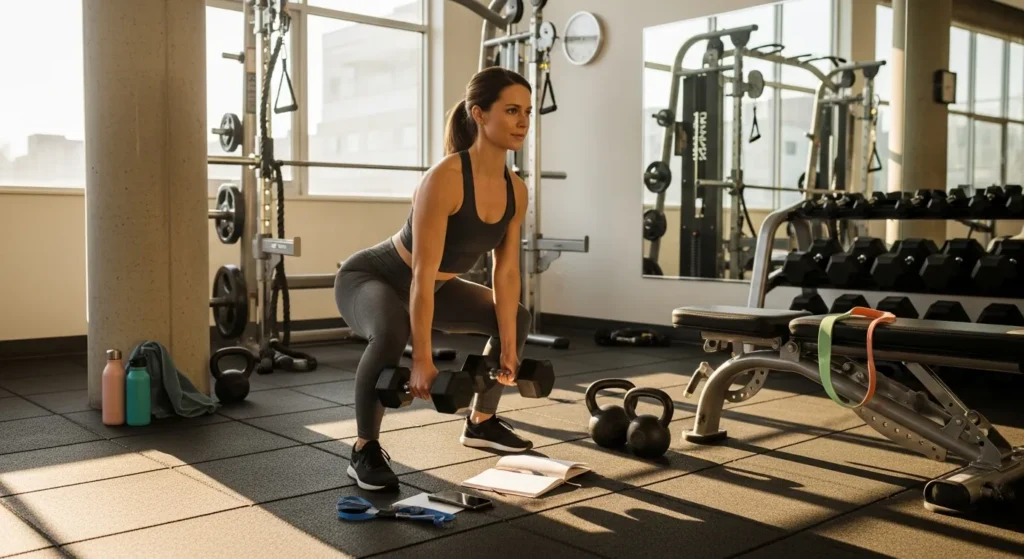
Picture this: you’re doing “all the right things”, you lift a couple days a week, you try to eat decent, you’re busy (because of course you are), and yet your results feel… random. Some weeks you feel strong and energized. Other weeks, you’re sore, stalled, and wondering if you should be doing totally different workouts.
That’s exactly why this guide exists. The best resistance training for women isn’t a single magic program, it’s the approach that matches your goal, your schedule, your body, and your current training age. And the good news? The science is actually pretty reassuring: you don’t need marathon workouts or complicated splits to get noticeably stronger, more “toned,” and more resilient.
Let’s make it practical, evidence-based, and realistic, so you can train with confidence instead of constantly second-guessing.
What “Best” Means For Women: Goals, Lifestyle, And Training Age
The internet loves to argue about the “best” workout. But in real life, the best resistance training plan is the one you can repeat consistently, recover from, and progress on, without it taking over your whole calendar.
A good starting question is: What do you want this training to do for you? Stronger? Leaner? Better posture? More muscle in your glutes? Less back pain? Better bone density as you age?
And just as important: How much time and mental energy do you actually have right now? Two focused sessions done for 6 months beats four chaotic sessions for 3 weeks. Every time.
Strength, Muscle Tone, Fat Loss, And Bone Health Outcomes
Resistance training is one of those rare habits that pays you back in multiple currencies.
- Strength: You get better at producing force. That shows up as easier groceries, better posture, fewer “tweaks,” and more confidence.
- Muscle tone (aka visible shape): “Tone” is mostly muscle + lower body fat + posture. Lifting builds the muscle part.
- Fat loss: Lifting doesn’t “burn fat” as directly as cardio, but it helps you keep muscle while dieting and supports daily energy output. Pair it with a modest calorie deficit and you’re in business.
- Bone health: Loading your bones (through strength training and impact, when appropriate) is one of the most supported strategies to maintain bone density over time.
If you’re in perimenopause or postmenopause, resistance training gets even more valuable. Muscle and strength become protective, against falls, frailty, and that creeping “I’m not as capable as I used to be” feeling.
Beginner Vs. Intermediate Vs. Returning After Time Off
Your “training age” matters more than your actual age.
- Beginner (0–6 months of consistent lifting): You’ll progress quickly. You need simple movement patterns, conservative volume, and lots of practice with form.
- Intermediate (6+ months, can repeat workouts and add load/reps steadily): You’ll need a bit more structure, planned progression, enough volume to stimulate growth, and good recovery.
- Returning after time off (injury, life, holidays, new baby, work chaos): Your strength will come back faster than you think (muscle memory is real). But your connective tissues and tolerance for volume might lag behind, so you ramp up gradually.
A helpful mindset: you’re not “starting over.” You’re rebuilding capacity, and doing it smarter this time.
Quick self-check: If you’re not sure where you fall, choose the beginner plan for 4–6 weeks. If you feel under-challenged and recover easily, move up.
The Core Principles That Make Resistance Training Work
You can use dumbbells, machines, bands, barbells, or a suspension trainer, and still get great results, if you follow a few principles.
These basics are what make resistance training “work” in the first place.
Progressive Overload Without Overwhelm
Progressive overload means you gradually ask your body to do a little more over time. That “more” can be:
- more weight
- more reps with the same weight
- more sets
- better technique and range of motion
- shorter rest (sometimes)
But here’s the part people miss: overload should feel like a steady nudge, not a weekly demolition.
A simple way to do it without obsessing:
- Pick a rep range (say 8–12).
- When you can do 12 reps with solid form for all sets, increase the weight next time.
Smart Exercise Selection: Squat, Hinge, Push, Pull, Carry, Core
If you’re overwhelmed by exercise options, use movement patterns instead of “random lists.” A well-rounded plan usually includes:
- Squat (goblet squat, leg press)
- Hinge (Romanian deadlift, hip thrust)
- Push (push-up, dumbbell bench)
- Pull (row variations, lat pulldown)
- Carry (farmer’s carry, suitcase carry)
- Core stability (planks, dead bug, Pallof press)
This hits major muscle groups, supports posture, and builds the kind of strength that transfers to real life.
Volume, Intensity, And Rest: The Minimum Effective Dose
If you’re busy, this is the most freeing concept: you don’t need endless volume.
Research in resistance-trained women found that 5–10 sets per muscle group per week produced strength and muscle gains that were similar (and in some outcomes better) than much higher weekly volumes like 15–20 sets, suggesting diminishing returns past a certain point for many lifters.
For strength work, rest matters too. Studies comparing rest intervals show you can typically complete more quality work with longer rests, and for heavier sets, 2–5 minutes is a solid guideline.
Practical takeaways you can actually use:
- Most of your workouts can be 30–60 minutes.
- Start with ~6–10 hard sets per muscle group per week, then adjust.
- If you’re lifting heavy (or close to it), give yourself enough rest to keep form crisp.
And if you’re over 40: some research suggests a slightly higher-volume approach (still within reason) can be helpful for improving muscle mass and body composition, especially when balanced with good recovery and sessions that don’t drag on forever (think ~45 minutes, alternating days).
The Best Resistance Training Modalities (And When To Use Each)
Different tools are good for different seasons of life. The “best” modality is often the one you’ll do consistently, and that matches your joints, your confidence, and your environment.
Free Weights: Dumbbells, Barbells, And Kettlebells
Best for: strength, muscle, athleticism, and long-term progression.
Why they’re great:
- They train stabilizers and coordination.
- They’re efficient: one movement can hit a lot of muscle.
- They’re easy to progress (especially dumbbells and barbells).
Where people get stuck:
- Form can feel intimidating at first.
- Some lifts (like barbell back squats) aren’t “required” and may not be the best fit for every body.
If you want a simple entry point: dumbbells are the sweet spot. You can get strong with goblet squats, Romanian deadlifts, rows, presses, and lunges for a long time.
Machines And Cables: Joint-Friendly Consistency And Isolation
Best for: beginners building confidence, hypertrophy-focused training, joint-friendly training, and consistent form.
Why they’re great:
- Stable setup = you can push effort without worrying as much about balance.
- Easy to target specific muscles (glutes, hamstrings, lats, delts).
- Great for higher-rep work when your joints don’t love heavy free weights.
Cables deserve a special shout-out for being both joint-friendly and “functional.” A cable row, cable press, or Pallof press can make your training feel smooth and controlled.
Bands And Bodyweight: Travel-Proof, Low-Barrier Training
Best for: home workouts, travel, postpartum basics, rehab-ish phases, and building consistency.
Bands and bodyweight work surprisingly well when you:
- train close enough to failure (within a couple reps)
- slow down the tempo
- use harder variations over time
Band rows, banded glute bridges, split squats, push-ups (incline counts.), and monster walks can absolutely maintain, and often build, strength when life is hectic.
If you’re thinking, “But is band training real resistance training?” Yes. Muscles don’t know the brand name of the tool. They respond to tension and progression.
Best Weekly Programs By Goal (2–4 Days/Week Options)
These templates are built around the minimum effective dose idea, enough work to progress, not so much that you dread it.
A few ground rules:
- Start each session with 5–8 minutes of warm-up: brisk walk, bike, or easy dynamic moves.
- For most lifts, keep 1–3 reps in reserve (you’ll learn this below).
- Rest 1–2 minutes for moderate sets, 2–5 minutes for heavier strength sets.
2-Day Full-Body Plan For Busy Schedules
Best for: consistency, fat loss support, beginners, busy seasons.
Day A
- Goblet squat or leg press: 3 x 6–10
- Dumbbell bench press or push-ups: 3 x 8–12
- One-arm dumbbell row or cable row: 3 x 8–12
- Romanian deadlift (DB) or hip hinge machine: 2 x 8–12
- Plank or dead bug: 2–3 sets
Day B
- Hip thrust (barbell/DB) or glute bridge: 3 x 8–12
- Lat pulldown or assisted pull-up: 3 x 8–12
- Split squat or step-up: 2–3 x 8–12/side
- Dumbbell overhead press or machine press: 2–3 x 8–12
- Suitcase carry: 3 x 30–60 seconds/side
Progression: Add 1 rep per set each week until you top the range, then increase weight.
3-Day Full-Body Plan For Strength And Muscle
Best for: balanced progress, “tone,” stronger lifts, better posture.
Day 1 (Squat + Push emphasis)
- Squat pattern (goblet/front squat/leg press): 3 x 5–8
- Bench press (DB/bar) or push-ups: 3 x 6–10
- Row (cable/DB): 3 x 8–12
- Hamstring curl (machine/band): 2–3 x 10–15
- Pallof press: 2–3 x 10–12/side
Day 2 (Hinge + Pull emphasis)
- Romanian deadlift or trap-bar deadlift: 3 x 5–8
- Lat pulldown/pull-up: 3 x 6–10
- Overhead press: 2–3 x 6–10
- Walking lunges: 2 x 10–14 steps/side
- Calf raises: 2–3 x 10–15
Day 3 (Glutes + Upper back/posture)
- Hip thrust: 3 x 6–10
- Incline DB press: 2–3 x 8–12
- Chest-supported row or cable row: 3 x 8–12
- Lateral raise: 2–3 x 12–20
- Carry (farmer’s): 3 rounds
This setup also plays nicely with non-linear rep ranges (rotating weeks of heavier and lighter rep targets), which research suggests can be effective for building multiple qualities over time.
4-Day Upper/Lower Split For Faster Progress
Best for: intermediate lifters who recover well and want faster strength/muscle gains.
Lower 1 (Strength bias)
- Squat/leg press: 4 x 4–6
- Romanian deadlift: 3 x 6–8
- Split squat: 2–3 x 8–10/side
- Calves: 3 x 10–15
Upper 1 (Strength bias)
- Bench press: 4 x 4–6
- Row: 4 x 6–8
- Overhead press: 2–3 x 6–8
- Pulldown: 2–3 x 8–10
Lower 2 (Hypertrophy bias)
- Hip thrust: 3 x 8–12
- Hamstring curl: 3 x 10–15
- Leg extension: 2–3 x 10–15
- Glute med work (band walks): 2 x 15–25
Upper 2 (Hypertrophy bias)
- Incline DB press: 3 x 8–12
- Pulldown: 3 x 8–12
- Lateral raise: 3 x 12–20
- Biceps curl + triceps pressdown: 2–3 x 10–15
If you’re training 4 days/week, your superpower is recovery management: sleep, protein, and not turning every set into a grind.
The Best Exercises For Women (With Form And Modification Notes)
No, women don’t need “special” exercises. But you might benefit from a short list that’s particularly good for common goals: glute development, strong legs, capable upper body, and a stable core.
Below are high-return moves, with quick form cues and easy modifications.
Lower Body: Glutes, Quads, Hamstrings, Calves
1) Hip thrust / glute bridge
- Cue: ribs down, chin tucked slightly, drive through midfoot/heel.
- Modify: start with bodyweight + pause at the top: use a bench for hip thrusts when ready.
2) Squat variations (goblet squat, front squat, leg press)
- Cue: keep your whole foot planted: knees track roughly over toes.
- Modify: elevate heels slightly or use a box target if depth is tricky.
3) Romanian deadlift (RDL)
- Cue: push hips back like you’re closing a car door: keep lats “packed.”
- Modify: reduce range of motion: use dumbbells: practice with a dowel along your spine.
4) Split squat / Bulgarian split squat
- Cue: slight forward torso lean: keep front foot flat.
- Modify: start with a regular split squat holding onto a support.
5) Hamstring curl (machine or band)
- Cue: control the lowering: don’t rush.
- Modify: stability ball leg curls are a great at-home option.
6) Calf raises (standing or seated)
- Cue: full stretch at the bottom, controlled rise.
- Modify: do them on a step while holding a railing.
Upper Body: Back, Chest, Shoulders, Arms, Grip
1) Row (one-arm DB, cable, or chest-supported row)
- Cue: pull elbow toward your back pocket: don’t shrug.
- Modify: chest-supported row reduces low-back fatigue.
2) Lat pulldown / assisted pull-up
- Cue: think “elbows down,” not “hands down.”
- Modify: use neutral grips: adjust the range if shoulders feel pinchy.
3) Dumbbell bench press / push-ups
- Cue: wrists stacked, shoulder blades gently back and down.
- Modify: incline push-ups are legit, and often better for building clean reps.
4) Overhead press (DB or machine)
- Cue: glutes tight, ribs down: press slightly back.
- Modify: do half-kneeling DB presses for core control.
5) Accessory arms + grip
- Curls, triceps pressdowns, and farmer’s carries aren’t “vanity.” Strong arms and grip make everything else easier.
Core And Posture: Anti-Rotation, Anti-Extension, And Carries
If you’ve ever done a million crunches and still felt unstable, this is why: your core’s main job is often to resist motion, not create it.
Anti-extension (resist arching):
- Dead bug
- Plank variations
- Ab wheel (advanced)
Anti-rotation (resist twisting):
- Pallof press
- Cable chops (controlled)
Carries (core + posture + grip + conditioning):
- Farmer’s carry (both hands)
- Suitcase carry (one hand)
Form cue that fixes a lot: exhale, ribs down, then move. It’s simple, and it works.
How To Progress Safely: Sets, Reps, Load, And Tracking
Progress is the whole point, otherwise you’re just exercising (which is still fine, but you said you wanted results).
The trick is progressing in a way your joints and schedule can tolerate.
Rep Ranges For Strength Vs. Muscle Vs. Endurance
You don’t need one “perfect” rep range. But it helps to match ranges to goals:
- Strength focus: ~3–6 reps (heavier, longer rest)
- Muscle focus (hypertrophy): ~6–12 reps (moderate-heavy)
- Muscular endurance: ~12–20+ reps (lighter, more burn)
In real life, a blended approach works well. Some research protocols for trained women used non-linear programming, cycling rep ranges week to week (for example 12–15, then 4–6, then 10–12, then 6–8). That variety can help you build strength and muscle while keeping training interesting.
RPE/Reps-In-Reserve For Autoregulation
Your body isn’t a robot. Sleep, stress, your cycle, travel, and work deadlines all change how weights feel.
That’s where RPE (rate of perceived exertion) or reps in reserve (RIR) comes in.
- 2 RIR = you could do 2 more reps with good form.
- 1 RIR = one more rep left.
- 0 RIR = true failure.
Most of your training should live around 1–3 RIR.
Why? You’ll still grow and get stronger, but you’re less likely to fry your recovery or aggravate something.
Deloads, Plateaus, And When To Change The Plan
If you’re doing the work and not progressing, don’t panic and program-hop. Check the basics first:
- Are you eating enough protein?
- Are you sleeping enough to recover?
- Are you adding load/reps too aggressively?
- Are you doing too much volume?
Deload idea (simple and effective):
For 1 week, keep the same exercises but cut:
- sets in half or
- weight by ~10–20% or
- effort (stay at ~3–4 RIR)
Plateaus are normal. Often, you just need a small tweak:
- swap one exercise (e.g., back squat → leg press)
- change rep ranges for 4 weeks
- add 1 set to a lagging muscle group
Tracking doesn’t have to be fancy. A notes app is enough. Record:
- exercise
- weight
- reps
- how hard it felt (RIR)
If you can prove you’re doing more than last month, you’re winning.
Recovery And Support: Nutrition, Hormones, And Injury Prevention
Training is the stimulus. Recovery is where the adaptation happens.
If your workouts are solid but you’re constantly sore, exhausted, or nagged by pain, this section is your upgrade.
Protein, Creatine, And Timing Basics For Real Life
Protein: If you want strength, muscle tone, and better recovery, protein is non-negotiable.
A practical target for many active women is about 25–35 grams per meal, 3–4 times per day (adjust to your body size and preferences). If tracking macros stresses you out, just anchor each meal with a protein.
Creatine monohydrate: One of the most studied supplements for strength and lean mass.
- Typical dose: 3–5 g/day
- No special timing required
- Drink enough water and be consistent
Timing: You don’t need a perfect post-workout shake window. But it helps to get a protein-rich meal within a few hours of lifting, especially if you trained fasted or had a long gap since your last meal.
Sleep, Stress, And Soreness Management
If you want a “biohack” that actually works, it’s sleep.
Aim for:
- 7–9 hours when possible
- a consistent wake time
- a wind-down routine that doesn’t involve doom-scrolling (hard, I know)
Soreness tips that help without derailing you:
- Keep moving: light walking or cycling increases blood flow.
- Don’t smash the same muscle group hard two days in a row.
- Manage volume: more is not always better.
Research-based programming guidance also supports spacing sessions: allow at least one day (and usually 48 hours is a sweet spot) before you hit the same muscle group hard again.
Common Pain Points: Knees, Low Back, Shoulders, And Wrists
Pain is common, but it’s not something you should “push through” blindly.
Knees
- Try: step-ups, split squats with shorter range, leg press with controlled depth.
- Cue: keep foot tripod (big toe, little toe, heel) grounded.
Low back
- Try: chest-supported rows, trap-bar deadlifts, hip thrusts instead of deep hinges.
- Cue: brace first (exhale, ribs down), then lift.
Shoulders
- Try: neutral-grip presses, cable work, landmine press.
- Watch: overly flared elbows and too-wide grips.
Wrists
- Try: dumbbells instead of straight bars, push-up handles, neutral grips.
- Modify: lighten load and build tolerance gradually.
If something hurts sharply, causes numbness/tingling, or worsens week to week, it’s worth consulting a qualified clinician (especially if it changes your daily function). That’s not being dramatic, that’s being smart.
If you’re the kind of person who likes systems: treat your training like you’d treat choosing a tool at work. You don’t buy the “most advanced” software just because it’s advanced, you pick what fits your needs, integrates with your life, and delivers consistent results. Same energy here.
Conclusion
The best resistance training for women is the plan you can recover from and progress on, week after week, without needing perfect motivation.
If you want a simple way to start today:
- Pick 2–3 full-body sessions per week.
- Build around squat, hinge, push, pull, and carries.
- Aim for 5–10 quality sets per muscle group per week to start.
- Track one thing: a rep PR or a small weight increase each week or two.
- Protect recovery like it’s part of training, because it is.
And honestly? Give yourself permission to be a “boring” lifter for a while. Boring is consistent. Consistent gets results. And results are pretty fun.