
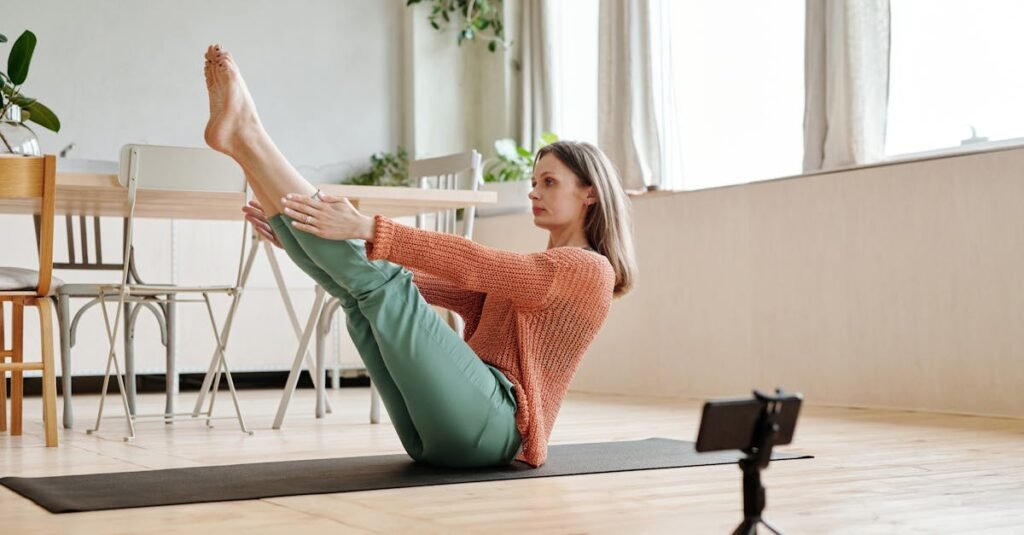
If you’ve ever stood up from your desk and felt like your hips forgot how to be hips… you’re not alone. Modern life is basically a tightness factory: lots of sitting, lots of screens, not a lot of natural movement.
The good news? A simple mobility workout can change how you move (and how you feel) fast, without turning your evenings into a two-hour stretching marathon.
Mobility training isn’t just “touch your toes and hope for the best.” It’s a mix of joint-friendly movement, strength-through-range, and nervous-system resets that help you feel looser and more stable. And yes, there’s solid research behind it: mobility work improves range of motion and overall musculoskeletal function, and it can support faster recovery and better movement mechanics over time.
Below, you’ll learn what mobility really is, how to build a routine that actually works, and you’ll get a no-equipment 15-minute full-body mobility workout you can do in your living room, today.
What Mobility Training Really Is (And Why It’s Not Just Stretching)
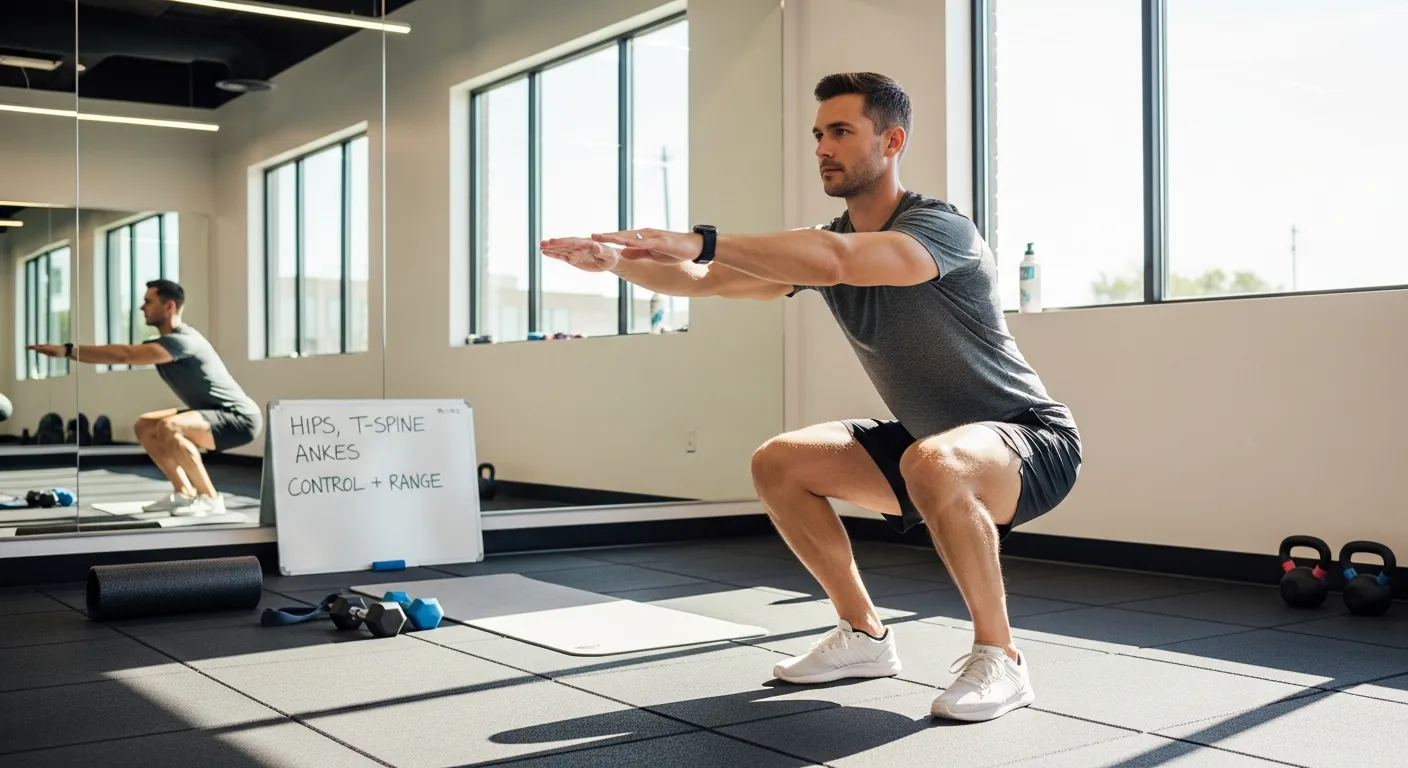
Mobility is one of those words that gets thrown around in gyms and on YouTube… and somehow ends up meaning “do a few random stretches.” But real mobility training is more specific, and way more useful.
Mobility training combines things like dynamic stretching, controlled joint rotations, and strength-based movements to improve your usable range of motion. The goal isn’t to become a human rubber band. It’s to help your joints move well, with control, so everyday movement (and workouts) feel smoother and less cranky.
When you do it consistently, mobility work can help “lubricate” joints by encouraging circulation of synovial fluid and improving blood flow to surrounding tissues, one reason many people feel less stiff afterward.
Mobility Vs. Flexibility Vs. Stability
These three get mixed up all the time. Here’s the clean way to think about it:
- Flexibility = how far a muscle can lengthen (often passive). Example: pulling your heel to your butt with your hand.
- Stability = how well you can control a joint and resist unwanted movement. Example: keeping your knee from caving in during a squat.
- Mobility = flexibility + stability + control in motion. Example: dropping into a squat under your own control and keeping your heels down, knees tracking well, and spine steady.
So if you’ve ever been “flexible” but still felt unstable (or got little aches), that’s the missing piece: mobility is flexibility you can actually use.
How Mobility Supports Joints, Posture, And Performance
A good mobility workout is like giving your body a software update.
For joints: Mobility training supports joint health by improving circulation and nutrient delivery to tissues. Controlled movement through range can reduce the sticky, rusty feeling many people get from being sedentary.
For posture: When your hips are stiff, your low back tends to do too much. When your upper back (thoracic spine) is locked up, your shoulders and neck often complain. Mobility drills help redistribute work to the right places, which can reduce strain patterns.
For performance: Better mobility can improve movement mechanics and help you access stronger positions, think deeper squats, cleaner lunges, smoother overhead reaches. Some sports research also suggests mobility-focused work can improve recovery time and skill acquisition (e.g., reduced recovery time and faster technique learning reported in athletic contexts).
If you want the simplest takeaway: mobility helps you move more like a capable human… not like a folded-up laptop.
Quick note: If pain is persistent, sharp, or worsening, it’s worth checking in with a qualified physical therapist or clinician. Mobility is powerful, but it’s not a substitute for medical care when something’s truly injured.
How To Build A Mobility Workout That Actually Works
The biggest mistake people make with mobility is doing random drills with no clear plan, then wondering why nothing changes.
A better approach is simple: pick what you need, train it with intent, and repeat it often enough that your body keeps the upgrade.
The “Assess, Open, Activate, Integrate” Framework
Here’s a framework you can use anytime, whether you’ve got 6 minutes or 30.
- Assess (30–60 seconds)
Ask: What feels restricted today? Common tells:
- Squat feels tight in ankles/hips
- Overhead reach feels pinchy in shoulders
- Neck feels forward and tense after laptop time
- Open (3–6 minutes)
Use gentle, controlled drills to open range of motion, think breath-led movements, dynamic stretches, and slow joint circles.
- Activate (3–6 minutes)
Teach your body to own the new range by engaging key muscles. Example: after opening hips, activate glutes: after opening upper back, activate mid-back and rotator cuff.
- Integrate (2–5 minutes)
Put it into a real pattern: squat, hinge, lunge, crawl, reach, carry (even if it’s just bodyweight). This is where mobility becomes usable.
This is how you avoid the “I stretched but I’m still tight” loop.
How Long, How Often, And When To Do It
You don’t need perfection. You need frequency.
- How long? 10–20 minutes is a sweet spot for most people. Even 5 minutes can help if you do it consistently.
- How often? Aim for 3–6 days/week. Mobility responds really well to “little and often.”
- When to do it? Pick what fits your life:
- Morning: great for stiffness, energy, and setting posture for the day
- Pre-workout: excellent as a warm-up primer (especially hips/ankles/upper back)
- Evening: calming, helps downshift your nervous system, can support sleep
One practical tip: treat mobility like brushing your teeth. If you only do it once in a while for 45 minutes, you won’t get the same payoff as 10 minutes most days.
And if you’re the kind of person who loves systems (same), try habit-stacking it: mobility right after coffee, right before your shower, or immediately after you shut your laptop.
A 15-Minute Full-Body Mobility Workout (No Equipment)
This is your plug-and-play mobility workout. No equipment. No fancy transitions. Just the stuff that tends to help the most people: breath, spine control, hips/ankles, and upper back/shoulders.
How to use it:
- Move slowly enough to feel what’s happening.
- Keep pain at a 0–3 out of 10 (mild intensity is fine: sharp pain isn’t).
- Do this 3–5x/week for two weeks and notice what changes.
Warm-Up Reset: Breath And Spine Control
1) 90/90 breathing (on back, feet on wall or chair), 5 breaths
- Knees and hips at ~90 degrees.
- Exhale fully like you’re fogging a mirror, feel ribs drop.
- Inhale quietly through your nose.
Why: Helps your ribcage/pelvis stack better, which can instantly change how your hips and shoulders move.
2) Cat-Cow (slow), 6 reps
- Move one vertebra at a time.
- Exhale into the “cat,” inhale into the “cow.”
3) Quadruped thoracic rotations, 5/side
- On all fours, one hand behind head.
- Rotate elbow toward ceiling without dumping into low back.
Hips And Ankles: Squat And Gait Essentials
4) Half-kneeling hip flexor rock-backs, 6/side
- Half-kneel (one knee down). Slight tuck of pelvis.
- Gently rock forward until you feel the front of the hip open.
5) 90/90 hip switches, 6 total
- Sit with knees bent, rotate legs side to side.
- Stay tall: go slow.
6) Knee-to-wall ankle rocks, 8/side
- Stand facing a wall, foot a few inches back.
- Drive knee toward wall without heel lifting.
7) Assisted deep squat hold, 30–45 seconds
- Hold a door frame or countertop.
- Sit down into a squat, heels grounded.
- Breathe slowly: gently shift side to side.
Thoracic Spine And Shoulders: Desk-Proof Upper Body
8) Wall slides (or floor angels), 8 reps
- Back against wall (or on floor), ribs down.
- Slide arms overhead without shrugging.
9) Scapular push-ups, 8 reps
- High plank or incline on a counter.
- Keep elbows straight: pinch shoulder blades together then push the floor away.
10) Thread-the-needle, 5/side
- From all fours, slide one arm under, rotate and breathe.
Finish (optional): 30 seconds of easy marching in place, focusing on tall posture and smooth arm swing.
If you want a simple “success metric”: after this routine, your squat, reach, and walking stride should feel smoother, not forced, just… easier.
Targeted Mobility For Common Tight Spots (Choose What You Need)
Not every body needs the same drills. The smartest mobility plan is targeted: pick 1–2 tight spots and rotate them through the week.
Below are the big three that show up for desk workers, runners, lifters, and pretty much anyone who’s been alive on the internet.
Hips: Flexors, Glutes, And Internal Rotation
When hips lose options, your low back often picks up the slack.
Try this mini-sequence (5–7 minutes):
- Couch stretch (gentle), 45 seconds/side
Keep ribs down, squeeze the glute on the back leg.
- Figure-4 glute stretch, 45 seconds/side
On back, ankle over knee, pull in.
- Seated or prone hip internal rotation lifts, 6 reps/side
Move slowly: small range is fine.
Why internal rotation matters: It’s a common “missing” hip motion, and when it’s limited, knees and low back can get cranky during squats, running, and even walking.
Ankles: Dorsiflexion For Knees And Squats
If your ankles don’t bend well, your body finds a workaround: heels lift, knees cave, arches collapse, or you tip forward.
Try this (4–6 minutes):
- Knee-to-wall test + rocks, 8 reps/side
Track progress by measuring how far your toes are from the wall when your knee can still touch.
- Calf eccentric lowers on a step, 6 reps/side
Slow 3–4 seconds down.
- Tibialis raises (back against wall), 10 reps
Lift toes toward shins: control the lowering.
This combo hits both range and strength, because loose ankles without control aren’t the goal.
Shoulders: Overhead Range Without Pinching
Overhead stiffness often isn’t just “tight shoulders.” It can be a blend of rib flare, limited thoracic extension, and weak upward rotation control at the shoulder blade.
Try this (5–8 minutes):
- Foam roller optional thoracic extensions (or towel roll), 6 breaths
Gentle, breathe into the ribs.
- Wall slide with lift-off (tiny), 6 reps
Slide up, then lift hands 1 inch off the wall without shrugging.
- Side-lying open books, 6/side
Rotate from upper back, not low back.
If overhead work consistently feels pinchy in the front of the shoulder, don’t grind through it. Clean up thoracic mobility + scapular control first, and consider getting assessed by a PT or qualified coach.
How To Progress Safely And Avoid Common Mobility Mistakes
Mobility should make you feel better in your body, not like you’re picking a fight with it.
A few small rules will keep you progressing without collecting weird aches.
Pinchy Pain Vs. Productive Stretch: What To Watch For
Use this quick filter:
Productive sensations usually feel like:
- Mild-to-moderate stretch in muscle belly
- Warmth, increased circulation
- A sense of “opening” that improves with slow breathing
Red flags usually feel like:
- Sharp, pinchy, or catching joint pain
- Tingling, numbness, radiating pain
- Pain that spikes after you stop (or lingers into the next day)
If it’s pinchy, back off the range, change the angle, slow down, or swap the drill. More intensity isn’t more progress.
Progressions: Range, Control, Load, And Speed
Mobility is trainable, and you can progress it like anything else. Here’s the order that tends to work best:
- Range, Can you access a little more motion comfortably?
- Control, Can you control that motion slowly (no wobble, no shortcuts)?
- Load, Can you own it with resistance (light dumbbell, tempo bodyweight, carries)?
- Speed, Can you use it dynamically (sport, running, jumps, quick changes of direction)?
A simple example:
- Start with a supported deep squat hold (range)
- Add slow goblet squat tempos (control)
- Increase weight gradually (load)
- Then use it in faster movements if your goals require it (speed)
Common mistakes to avoid:
- Only stretching what feels tight (tight is often weak + guarded)
- Skipping activation (your body won’t “keep” range it can’t control)
- Doing mobility once a week (frequency beats hero sessions)
- Chasing end range every rep (stay smooth: flirt with the edge, don’t live there)
How To Fit Mobility Into A Busy Week (Micro-Routines That Stick)
The best mobility workout is the one you’ll actually do when life is busy, your calendar is rude, and you don’t feel like “starting.”
So let’s make it easy.
Desk Breaks, Pre-Workout Primers, And Evening Wind-Downs
Pick one option for each day, think of it like choosing a playlist.
Option A: 3-minute desk break (2–3x/day)
- 3 slow nasal breaths, long exhale
- 5 neck nods + 5 gentle turns each way
- 8 standing hip hinges (hands on hips)
- 8 wall ankle rocks per side
Option B: 6-minute pre-workout primer
- Cat-cow x 6
- 90/90 switches x 6
- Knee-to-wall rocks x 8/side
- Scapular push-ups x 8
Option C: 8-minute evening downshift
- 90/90 breathing: 5 breaths
- Seated forward fold (gentle): 60 seconds
- Open books: 6/side
- Child’s pose with side reach: 30 seconds/side
If you’re tracking habits, keep it stupid simple: check a box for “mobility done” rather than micromanaging the perfect routine.
Pairing Mobility With Strength Training For Long-Term Results
Mobility and strength are best friends. Strength training helps you keep mobility because it teaches your body that new ranges are safe and useful.
Here’s a simple weekly setup that works for many busy people:
- 2–4 days/week strength training (full-body or upper/lower)
- 10 minutes mobility before lifting (target the joints you’ll use)
- 5 minutes mobility after lifting (cool-down + breathing)
- 1 longer mobility session on the weekend (15–25 minutes)
A practical pairing idea:
- If you’re squatting or deadlifting: prioritize hips + ankles + bracing/breath
- If you’re pressing overhead or doing pull-ups: prioritize thoracic spine + shoulders + scap control
Over time, this combo is what tends to create that “I just move better now” feeling, less stiffness, less random soreness, more energy.
And if motivation is your bottleneck, make it frictionless: keep a short routine pinned in your notes app, or schedule it like a meeting. (You wouldn’t skip a client call… treat your joints with the same respect.)
Conclusion
A solid mobility workout isn’t about chasing extreme flexibility, it’s about giving your body more options, then teaching it to use those options with control.
If you do nothing else, do this: pick the 15-minute routine above and run it 3–5 times a week for the next two weeks. Pay attention to the small wins, getting off the couch easier, squatting without heel lift, reaching overhead without that weird shoulder pinch, feeling less “compressed” after a long day.
Mobility is one of the few fitness habits that pays you back in multiple currencies: less pain, better workouts, smoother posture, and honestly… more energy.
And you don’t need to overhaul your life. You just need a repeatable plan, and a few minutes a day where you move like you actually live in your body.