You don’t need a gym membership, fancy equipment, or an hour a day to work on your waistline.
If you’re looking for exercise to reduce belly fat for female at home, the real challenge usually isn’t motivation, it’s confusion. Do you need endless crunches? Heavy weights? Hardcore HIIT? And how does this all fit around work, kids, and a life that already feels full?
This guide walks you through a realistic, science‑backed approach to reducing belly fat at home. You’ll learn what actually works for women’s bodies, how to structure short but effective workouts, and how to support your efforts with simple lifestyle tweaks, without obsessing over perfection.
Why Belly Fat Is Stubborn And What Actually Works
For many women, belly fat is the last to go and the first to show up. That’s not your imagination, it’s biology, hormones, and lifestyle all working together.
From a science point of view, belly fat hangs on when:
- You’re consistently in a calorie surplus (eating more than you burn)
- You’re under chronic stress and not sleeping well
- You’re losing muscle from being inactive or doing only cardio
To reduce belly fat, your body needs:
- A modest calorie deficit (through food, movement, or both)
- Regular cardio to burn energy and improve heart health
- Strength training to protect and build muscle (which helps your metabolism)
- Lower stress and better sleep so your hormones stop fighting you
At‑home exercise is powerful because it helps you create that calorie deficit, keep your muscles active, and improve your overall health, without adding more stress to your day.
Understanding Types Of Belly Fat (Subcutaneous vs. Visceral)
Not all belly fat is the same.
- Subcutaneous fat is the soft, pinchable fat just under your skin. It’s what you see when you grab a roll at your waist.
- Visceral fat sits deeper in your abdomen, wrapped around your organs. This type is more strongly linked to health risks like heart disease and insulin resistance, especially in women.
You can’t see visceral fat directly, but you can use your waist as a clue. For most women, a waist over about 35 inches (89 cm) is a sign there may be more visceral fat than is ideal.
The good news? The same habits that help you lose overall body fat, cardio, strength training, and better nutrition, also help reduce visceral fat.
Can You Really Spot‑Reduce Belly Fat?
Short answer: no. You can’t force your body to burn fat from one specific area, like your belly, by only doing ab exercises.
When you lose fat, your body pulls it from all over, based on genetics, hormones, and individual patterns. That’s why some people notice slimmer arms first, others see changes in their face or hips.
But ab and core exercises still matter. They:
- Tone and strengthen the muscles under your belly fat
- Improve posture, which can instantly make your midsection look flatter
- Support your back and hips, reducing pain and improving movement
So you won’t crunch your way to spot‑fat loss, but you will build a stronger, tighter midsection that shows more as your overall body fat comes down.
How Hormones, Stress, And Age Affect Belly Fat In Women
Hormones are a big reason belly fat can feel different, and more stubborn, for women.
- Estrogen: Before menopause, estrogen tends to store more fat around your hips and thighs. As estrogen levels drop with age and menopause, your body may shift to storing more visceral fat around your belly.
- Cortisol (the stress hormone): Ongoing stress, poor sleep, and emotional overload can keep cortisol high. Elevated cortisol is linked to increased abdominal fat storage.
- Insulin: Diets high in ultra‑processed foods and added sugar can affect insulin, which also plays a role in how your body stores fat.
The takeaway: You’re not “failing” if your belly looks different in your 40s or 50s than it did in your 20s. Your job now is to work with your body, using smart exercise, better stress management, and sleep, to gently shift the balance in your favor.
Foundations First: How Much And What Kind Of Exercise You Need

If your goal is to reduce belly fat at home, think of movement as a three‑part system: cardio, strength training, and everyday activity.
Most research and expert guidelines suggest women aim for:
- 150–300 minutes per week of moderate cardio or 75–150 minutes of vigorous cardio
- 2–3 days per week of full‑body strength training
At home, that can look like short 15–30 minute sessions spread across your week.
Balancing Cardio, Strength Training, And NEAT
You’ll get the best results when you combine:
- Cardio (aerobic exercise)
- Examples at home: marching in place, dancing, brisk walking, step‑ups, stair climbing, low‑impact standing abs, or simple HIIT intervals.
- Role: Burns calories, improves heart health, helps reduce visceral fat.
- Strength training
- Examples: squats, lunges, planks, push‑ups against a wall or counter, glute bridges, core exercises.
- Role: Builds and protects muscle, which supports your metabolism and body shape.
- NEAT (Non‑Exercise Activity Thermogenesis)
- Basically, all the movement you do outside of official workouts: housework, gardening, walking while on calls, pacing while you think.
- Role: Surprisingly powerful for burning additional calories without feeling like you’re “working out.”
When you’re short on time, NEAT can quietly make a big difference, taking the stairs, standing up every hour, or walking while you listen to a podcast.
How Often To Work Out For Belly Fat Loss
You don’t need daily 60‑minute sessions. For many busy women, a realistic starting point is:
- 3–5 days per week of focused at‑home exercise
- 15–30 minutes per session
For example:
- 2–3 days of cardio circuits
- 2 days of strength + core
You can always break this into shorter chunks, two 10‑minute sessions still count.
Warm‑Up And Safety Tips For At‑Home Workouts
A quick warm‑up prepares your joints, muscles, and nervous system so you feel better and stay safer.
Spend 3–5 minutes on:
- Gentle marching in place
- Arm circles (small to big, forward and backward)
- Hip circles and light torso twists
- A few cat‑cow movements on hands and knees or seated spine rolls
Core‑specific warm‑up ideas:
- Lie on your back with knees bent and gently imprint your spine into the floor (flatten your lower back slightly) while you exhale.
- Practice deep belly breaths, tightening your core as you breathe out.
Safety reminders:
- Keep your lower back supported, if an exercise makes your back pinch or ache, bend your knees or limit your range of motion.
- Move with control, not momentum.
- If you’re new to exercise, pregnant, recently postpartum, or have health conditions, talk with your healthcare provider before starting a new routine.
At‑Home Cardio Workouts To Burn Belly Fat
Cardio is your main tool for creating a gentle calorie deficit and targeting visceral fat. The good news: you can do effective cardio in your living room with zero equipment.
Low‑Impact Cardio Options (Beginner‑Friendly)
If you’re just starting, recovering, or protecting your joints, low‑impact doesn’t mean low results.
Try mixing 30–45 seconds of each with 15–30 seconds of rest:
- Marching in place: Pump your arms, lift your knees comfortably.
- Side steps with reach: Step side to side while reaching arms overhead or across your body.
- Seated leg lifts: Sit tall in a chair, alternate lifting your legs, engage your core.
- Standing knee drives: Hands above your head, pull your knee toward your chest as you bring arms down.
- Seated or lying scissor legs: On a mat or firm bed, gently alternate lifting and lowering straight legs, or keep knees bent for less strain.
Do 2–4 rounds for a 10–15 minute low‑impact session.
Moderate To High‑Intensity Interval Ideas (No Equipment)
Once you feel comfortable with basic movements, you can layer in short bursts of higher intensity. This burns more calories in less time and can boost your fitness.
Try 20–30 seconds of effort with 20–30 seconds of rest:
- Plank jacks (modified as needed): In a high plank, jump or step your feet out and in. Drop to elbows or step instead of jump for lower impact.
- Mountain climbers: From plank, drive one knee toward your chest, then switch. You can slow this down for a beginner‑friendly version.
- Modified burpees: Squat down, place hands on a chair or the floor, step or jump feet back to plank, step or jump in, stand up, and reach overhead.
- High‑knee marches or jogs: Drive knees up (marching if you’re low impact, jogging if you’re ready for more).
Aim for 8–12 intervals for a solid 12–15 minute at‑home HIIT session.
Sample 15‑Minute Fat‑Burning Cardio Circuit
Here’s a simple circuit focused on your core and cardio. Set a timer for 1 minute each exercise, rest 15–30 seconds between moves, then repeat the circuit 3 times.
- Flutter kicks (on your back)
- Hands under hips if needed, small fast kicks up and down. Bend your knees if your lower back feels strain.
- Dead bugs
- On your back, arms up, knees bent at 90 degrees. Slowly lower opposite arm and leg toward the floor, then switch sides. Keep your lower back pressed down.
- Plank hip taps
- In a forearm plank, gently tap one hip toward the floor, then the other. Make the movement small and controlled.
- Leg pumps
- Lying on your back, extend your legs toward the ceiling and pump them up and down a few inches. Bend your knees if needed.
- Boat hold
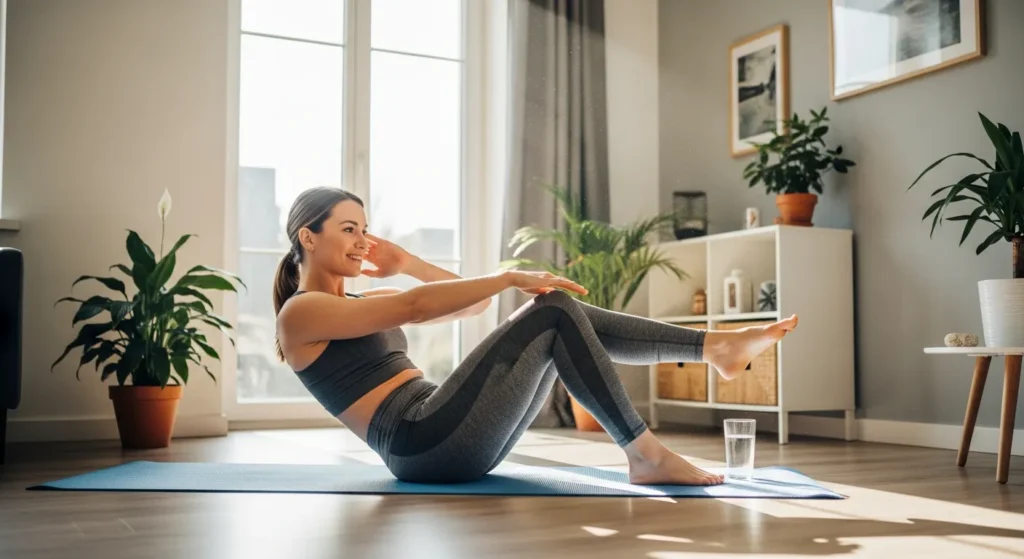
- Sit with knees bent, lean back slightly, chest lifted, and hold. Lift your feet off the floor for more challenge or keep toes down for support.
Repeat the circuit 3 times for about 15 minutes total. This style of workout is an efficient exercise to reduce belly fat for female at home, especially when you pair it with strength training and better nutrition.
Strength Training Moves That Target Core And Boost Metabolism
Strength training is non‑negotiable if you want a flatter, stronger midsection and healthy metabolism as you age. Muscle tissue burns more energy, supports your posture, and helps your body look more toned, even when the scale doesn’t change much.
Full‑Body Strength Exercises You Can Do In Your Living Room
Try these 2–3 times per week. Do 2–3 sets of 8–12 reps for each move.
- Squats: Stand with feet hip‑width apart, sit back like you’re going to a chair, then stand. Use a chair behind you if you’re nervous about balance.
- Glute bridges: Lie on your back, knees bent, feet flat. Press your heels into the floor and lift your hips, squeezing your glutes.
- Incline push‑ups: Hands on a wall, table, or counter. Walk your feet back and lower your chest toward your hands, then push away.
- Side lunges: Step to the side, bend that knee while the other leg stays straight, then push back to center. Great for hips and thighs.
- High plank hold: Hands under shoulders, body in a straight line. Hold 15–30 seconds.
Household items like water bottles, backpacks filled with books, or laundry detergent jugs can act as weights.
Core‑Focused Exercises For A Stronger, Flatter Midsection
These moves tighten and support the muscles around your waist.
- Bicycle crunches: On your back, hands behind your head, bring opposite elbow to knee while extending the other leg. Go slow and controlled.
- Russian twists: Sit with knees bent, lean back slightly, hold a water bottle or just clasp your hands, and twist side to side.
- Forearm plank: Elbows under shoulders, body in a straight line. Hold 20–40 seconds, breathing steadily.
- Supine leg circles: On your back, legs extended toward the ceiling (or slightly bent), draw small circles with your feet. Reverse direction.
- Straight‑legged sit‑ups: If comfortable for your back, lie flat with legs straight and sit up, reaching for your toes. Bend your knees if your back complains.
Aim to pick 3–4 core moves and do 2–3 sets.
Progressions: How To Make Exercises Easier Or Harder
You can adjust almost any exercise to match your current level.
To make moves easier:
- Bend your knees (instead of straight legs in core work)
- Shorten your range of motion
- Do push‑ups or planks on a wall or table
- Reduce time (hold for 10–15 seconds instead of 30–45)
To make moves harder:
- Add holds (pause at the hardest part of the movement)
- Increase time under tension (move more slowly)
- Add weights (water bottles, backpack, light dumbbells)
- Increase speed only once your form is solid
Listen to your body: your core should feel worked, not painful. Your lower back and joints should never feel sharp or pinched.
Putting It Together: Weekly At‑Home Belly Fat Workout Plan
Here’s how to turn all of this into a clear plan you can follow. Remember, consistency beats perfection.
Beginner 3‑Day‑Per‑Week Plan
If you’re newer to exercise or coming back after a break, start here.
Schedule example: Monday, Wednesday, Friday
Each day:
- Warm‑up (3–5 minutes)
March in place, arm circles, hip circles.
- 15‑minute cardio circuit
- Alternate 1 minute each of: marching in place, side steps with reach, standing knee drives, seated leg lifts, and low‑impact twists.
- Repeat the circuit 2–3 times.
- Planks
- Forearm plank: 3 x 20–30 seconds with 30–45 seconds rest.
Walk on at least 2 other days for 15–20 minutes if possible (even around your house or office).
Intermediate 4–5‑Day‑Per‑Week Plan
Once you’ve built a base, you can add more structure and challenge.
Sample weekly layout:
- Day 1: Cardio + core
- Day 2: Strength + core
- Day 3: Standing or walking cardio
- Day 4: Strength + core
- Day 5 (optional): Short HIIT session or longer walk
Example week:
- Day 1 – 15‑minute core cardio circuit (like the flutter kicks / dead bugs / plank hip taps / leg pumps / boat hold circuit)
- Day 2 – Strength
- Squats: 3 x 10–12
- Glute bridges: 3 x 12–15
- Incline push‑ups: 3 x 8–10
- Bicycle crunches: 3 x 12–15 per side
- Day 3 – 30‑minute standing cardio
Brisk walking, dancing, or a mix of marching, side steps, and knee drives.
- Day 4 – Strength + core
- Side lunges: 3 x 10 per side
- High plank: 3 x 20–30 seconds
- Russian twists: 3 x 15 per side
- Supine leg circles: 2–3 sets of 8–10 circles each direction
- Day 5 – 10–15 minutes HIIT
20 seconds mountain climbers, 20 seconds rest, then 20 seconds modified burpees, 20 seconds rest. Repeat 6–10 rounds.
This kind of schedule makes your at‑home routine a powerful exercise to reduce belly fat for female at home while also building strength and energy.
How To Adjust For Busy Schedules And Low‑Energy Days
Life happens. You won’t hit every workout perfectly, and you don’t need to.
On busy or low‑energy days:
- Do a “minimum effective” 8–10 minute session: choose 3–4 exercises and cycle through them.
- Use seated or low‑impact options: seated leg lifts, seated marches, gentle standing knee drives.
- Break it up: two 5‑minute “movement snacks“ (morning and evening) still count.
The goal is to protect your habit, not chase perfection. Keeping the routine alive makes it easier to ramp back up when life settles.
Lifestyle Tweaks That Make Your Belly Fat Workouts More Effective
Workouts matter, but what you do the other 23 hours of the day matters just as much.
Sleep, Stress, And Cortisol’s Role In Belly Fat
Poor sleep and chronic stress can quietly work against your fat‑loss efforts by raising cortisol, which is linked with more abdominal fat storage.
To support your hormones:
- Aim for 7–9 hours of sleep most nights.
- Create a wind‑down routine: dim lights, limit screens, read or stretch.
- Build in small stress‑relief moments: 5 deep breaths, a short walk, journaling, or a 3‑minute meditation.
You don’t have to eliminate stress (impossible), but you can teach your body to come back to calm more often.
Simple Nutrition Principles To Support A Flatter Belly
You don’t need a perfect diet to see progress around your waist, but you do need some structure.
Focus on:
- A gentle calorie deficit: slightly less energy in than you burn.
- Protein at most meals: eggs, Greek yogurt, beans, lentils, tofu, chicken, fish. Protein helps you stay full and protects muscle.
- Plenty of fiber: vegetables, fruits, whole grains, beans. Fiber supports digestion and the gut, which is tied to overall health.
- Limiting ultra‑processed foods and sugary drinks most of the time.
You can still enjoy treats, just anchor them in a mostly whole‑food pattern.
If your waist measures above 35 inches, that can be a sign to gently tighten up nutrition and movement habits, especially if you have other risk factors like high blood pressure or blood sugar issues.
Tracking Progress Beyond The Scale
The scale is just one data point, and often a frustrating one. Belly fat loss can show up in other ways first.
Try tracking:
- Waist measurements: Use a soft tape around your belly button, same spot and time of day each week.
- Photos: Front and side photos every 2–4 weeks in similar clothing and lighting.
- Strength gains: How long you can hold a plank, how many squats or push‑ups you can do.
- Energy and mood: Better sleep, less afternoon crash, improved confidence.
You’ll likely notice these improvements before you see a dramatic change on the scale, and they’re just as valuable.