If knee pain has you avoiding workouts, or even dreading the stairs, you’re not alone. Your knees do a lot of heavy lifting for you, and when they start to ache, everything from walking the dog to getting up from the couch can feel like a chore.
The good news? You don’t have to choose between being active and being in pain. The right low impact exercises for knee pain can actually reduce discomfort over time by strengthening the muscles that support your joints, improving mobility, and keeping inflammation in check.
In this guide, you’ll learn how to move in ways that feel good on your knees, how to spot red flags, and how to build a simple routine you can weave into a busy life.
Understanding Knee Pain And Why Low Impact Movement Helps
Common Types Of Knee Pain You Might Be Feeling
You don’t need a medical degree to start understanding what your knees are trying to tell you. Most everyday knee pain falls into a few common buckets:
- Osteoarthritis – Wear-and-tear on the cartilage that cushions your knee joint. You might feel stiffness in the morning, pain with long walks or stairs, or a dull ache by the end of the day. This becomes more common with age.
- Patellofemoral pain (“runner’s knee“) – Discomfort around or behind the kneecap. Often shows up when you sit for a long time, walk downhill, squat, or go down stairs.
- Meniscus irritation or tears – The meniscus is cartilage that acts like a shock absorber. You may feel sharp pain with twisting, squatting, or pivoting, sometimes with catching or clicking.
- Overuse or muscle imbalance – Tight quads or hip flexors, weak glutes, or poor movement patterns can all load the knee in a way it doesn’t like.
If you’ve had a recent injury (a pop, sudden swelling, or a specific accident), it’s worth getting checked out before you jump into any program.
How Low Impact Exercise Reduces Pain And Protects Joints
When your knee hurts, it’s tempting to stop moving altogether. The problem is, total rest can backfire.
Low impact exercise, think walking, cycling, swimming, gentle strength work, does a few key things for your knees:
- Lubricates the joint – Your cartilage doesn’t have its own blood supply. It relies on movement to get nutrients from joint fluid. Gentle motion is like an oil change for your knees.
- Strengthens supporting muscles – Strong quads, hamstrings, glutes, and calves act like scaffolding around the joint. Research on knee osteoarthritis consistently shows that strengthening these muscles can reduce pain and improve function.
- Improves alignment and control – When your hips and core are stable, your knee tracks more smoothly with each step, squat, or stair.
- Supports healthy weight and inflammation – Regular low impact cardio helps with weight management and overall inflammation, both of which reduce load on your knees.
So you’re not just “working around” the pain. You’re actively building a more resilient knee over time, without all the pounding of high-impact workouts like running or plyometrics.
Safety First: When To Get Checked And How To Protect Your Knees
Red Flags: When To See A Doctor Or Physical Therapist
Before you start (or ramp up) exercise, hit pause and talk to a healthcare professional if you notice:
- Sudden, intense pain after a twist, fall, or impact
- Significant swelling or your knee looking visibly bigger than usual
- Feeling like your knee might “give way” or can’t support your weight
- Locking or getting stuck when you try to bend or straighten
- Fever, redness, or warmth in the joint
- Pain that gets worse for more than a few days every time you try gentle movement
A physical therapist or sports medicine doctor can give you a clear diagnosis and customize exercises for your specific situation.
Smart Warmups And Alignment Tips Before You Start
Once you’ve ruled out anything serious, a few simple habits will protect your knees while you exercise:
- Warm up for 5–10 minutes – Try easy marching in place, gentle knee bends while holding on to a counter, or a slow walk.
- Think “knee over middle toe“ – When you squat or step, your knee shouldn’t collapse inward. Imagine tracking it toward your second or third toe.
- Shorten your range of motion – If a deep squat hurts, do a half or quarter squat. Pain-free quality beats depth every time.
- Use support as needed – Hold the back of a chair, use handrails on stairs, or choose a stationary bike instead of road cycling early on.
- Use the 0–10 pain scale – Mild discomfort around a 2–3 that eases after you warm up is usually okay. Sharp, increasing, or lingering pain (5–10) is a sign to back off.
Think of these as your knee’s “safety settings.“ They help you train smarter, not just harder.
Best Low Impact Cardio Options For Sore Or Sensitive Knees
Low impact cardio keeps your heart and lungs strong without pounding your joints. The key is choosing movements that feel smooth and controlled, not jarring.
Walking, Treadmill, And Elliptical: Joint-Friendly Guidelines
Walking is one of the simplest low impact exercises for knee pain, but how you do it matters:
- Start on flat, even surfaces (park paths, indoor tracks) before tackling hills.
- Wear supportive shoes: if your feet collapse inward, inserts or orthotics may help alignment.
- Begin with 5–10 minutes and add 2–5 minutes every few days if your knees tolerate it.
If outdoor terrain feels unpredictable, a treadmill can be easier to control:
- Keep the incline low at first (0–1%).
- Walk at a speed where you can still talk in full sentences.
- Hold lightly onto the rails only if you need balance, don’t lean your weight on them.
The elliptical mimics walking or jogging without impact:
- Adjust the resistance so it feels like light-to-moderate effort, not a leg press.
- Keep your heels grounded and posture tall.
- Test different stride lengths, shorter can feel better on cranky knees.
Cycling And Stationary Bike Tips For Knee Comfort
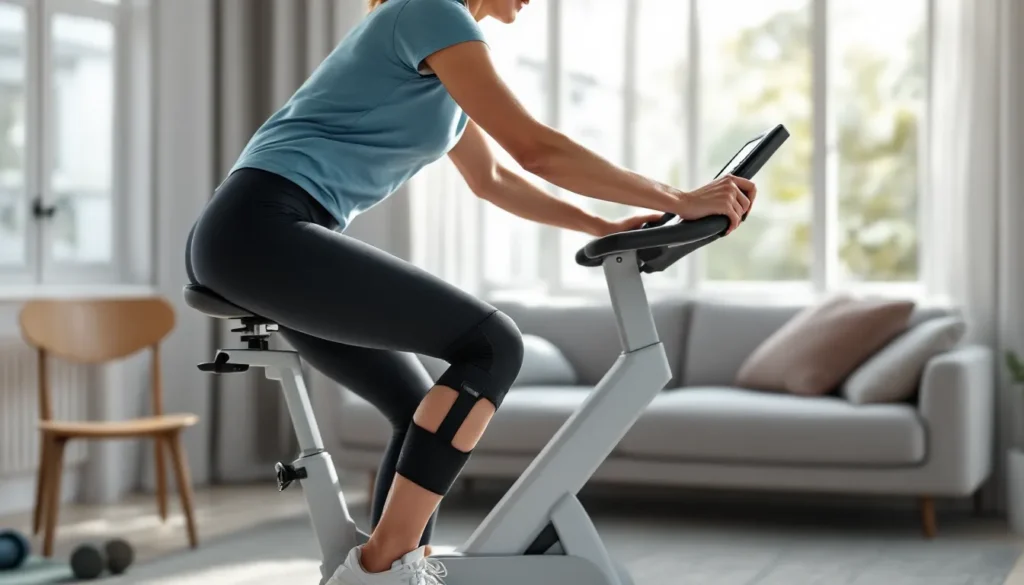
Cycling, especially on a stationary bike, is a classic choice for knee rehab and pain-friendly cardio.
- Set your seat height so your knee has a slight bend (about 25–30°) at the bottom of the pedal stroke. Too low = more pressure on the front of your knee.
- Start with low resistance and a smooth, easy cadence. You’re not racing: you’re circulating blood and waking up muscles.
- If bending your knee fully is uncomfortable, begin with partial revolutions, rock the pedals back and forth, then work up to full circles.
Over time, building strength in your quads and hamstrings on the bike can make everyday walking and stair-climbing feel easier.
Swimming And Deep-Water Exercise For Pain Relief
Water is your best friend when your knees are irritated.
- Swimming laps (especially freestyle and backstroke) lets you get your heart rate up while the water supports much of your body weight.
- Water walking or jogging in the shallow end challenges your muscles without the impact of land.
- Deep-water running with a flotation belt can mimic jogging while keeping your feet off the bottom completely.
The buoyancy of water unloads your knees, while the resistance strengthens your legs, hips, and core. Studies on aquatic exercise for knee osteoarthritis show improvements in pain, stiffness, and function, plus, it just feels good.
Strength Exercises To Support And Stabilize Your Knees
Low impact cardio is great, but strength training is where you create real structural support around the joint.
Core Principles For Knee-Friendly Strength Training
A few ground rules before you pick up any weights (or your own body weight):
- Prioritize form over load. If your knees cave inward, your back arches, or you’re holding your breath, it’s too much.
- Move in a pain-free range. It’s okay if your muscles feel challenged or mildly uncomfortable, but sharp joint pain is a no-go.
- Train 2–3 days per week. You don’t need daily strength sessions: your muscles actually get stronger during rest.
- Balance front and back of the leg. Quads, hamstrings, and glutes should all get some attention.
Beginner-Friendly Lower Body Strength Moves
You can do many of the best low impact exercises for knee pain at home with just a mat and maybe a resistance band.
Try these:
- Straight leg raises (front)
- Lie on your back, one knee bent, the other leg straight.
- Tighten the thigh of the straight leg and slowly lift it to the height of your bent knee.
- Lower with control.
- 2–3 sets of 8–12 reps per leg.
- Bridges
- Lie on your back with knees bent, feet hip-width apart.
- Press through your heels to lift your hips until your body forms a straight line from shoulders to knees.
- Pause, then lower slowly.
- 2–3 sets of 8–12 reps.
- Chair squats
- Stand in front of a sturdy chair, feet about hip-width apart.
- Push your hips back and bend your knees to sit down lightly, then stand back up.
- Keep your knees tracking over your middle toes.
- 2–3 sets of 6–10 reps.
- Step-ups (low step)
- Use a low step or stair.
- Step up with one foot, straighten your leg, then step down slowly.
- Hold a railing if needed.
- 1–2 sets of 6–10 reps per leg.
If any move bothers your knee, shorten the range (don’t go as low) or reduce reps.
Core And Hip Work To Take Pressure Off Your Knees
Strong hips and core help keep your thigh bone and shin tracking well, so your knee isn’t twisted or pulled.
Add:
- Side-lying leg lifts – Lie on your side, lift the top leg slightly back and up, keeping toes pointing forward or slightly down. Targets side glutes.
- Clamshells with or without a band – Lie on your side with knees bent, feet together, and open your top knee like a clamshell without rolling your hips back.
- Dead bugs – On your back, arms up, knees bent at 90°. Slowly extend one arm and the opposite leg, then switch. Helps core control.
These small, controlled movements can make a big difference in how stable and supported your knees feel when you walk, squat, or climb stairs.
Mobility, Stretching, And Balance Work To Keep Knees Happy
Gentle Mobility And Stretching For Tight Hips, Quads, And Calves
When the muscles around your knees are tight, they can tug on the joint and change how it moves. Gentle stretching helps restore normal motion without forcing anything.
Try after workouts or on rest days:
- Calf stretch at the wall – Hands on a wall, one foot back, heel down, front knee bent. Lean in until you feel a stretch in the back calf. Hold 20–30 seconds.
- Quad stretch (standing or side-lying) – Hold a wall or chair, bend one knee, and gently bring your heel toward your butt, keeping knees close together. If standing is hard, lie on your side and use a strap or towel.
- Hip flexor stretch – In a half-kneeling position (use a cushion), gently shift your weight forward until you feel a stretch in the front of the hip of the kneeling leg.
Aim for 1–2 rounds of each stretch per side, breathing calmly. You should feel a comfortable pull, not sharp pain.
Balance And Proprioception Drills To Prevent Future Injury
Good balance protects your knees when life throws you off, stepping off a curb, tripping over a toy, or pivoting on the court.
Simple drills:
- Single-leg stand – Stand near a counter. Lift one foot and balance for 10–20 seconds. To progress, look side to side or close one eye (only if safe).
- Tandem stand – Stand with one foot directly in front of the other, heel to toe, like you’re on a balance beam.
- Heel-to-toe walk – Slowly walk in a straight line, placing each foot directly in front of the other.
These small, low impact exercises help your body “learn” where your knee is in space so it can react quickly and stay stable.
Sample Weekly Low Impact Routine For Busy Schedules
You don’t need an hour a day to start feeling a difference in your knees. Consistency beats intensity every time.
10–20 Minute Routines You Can Slot Into Your Day
Here’s a simple, knee-friendly weekly plan you can adapt. Always adjust based on how your body feels.
Monday, Wednesday, Friday – Bike + Strength (10–20 minutes)
- 5–10 minutes easy cycling on a stationary bike
- Straight leg raises – 2–3 sets of 8–12 per leg
- Bridges – 2–3 sets of 8–12
Tuesday, Thursday – Gentle Cardio + Squats (10–15 minutes)
- 5–10 minutes water walking, light swimming, or a gentle yoga flow
- Chair squats – 2–3 sets of 6–10
- Optional: side-lying leg lifts – 2 sets of 10 per side
Saturday – Mix & Mobility (15–20 minutes)
- 5–10 minutes on the elliptical or a flat outdoor walk
- Calf, quad, and hip flexor stretches – 20–30 seconds each side
- 3–5 minutes of simple balance work (single-leg stand, heel-to-toe walk)
Sunday – Rest or light movement
- Easy stroll, light stretching, or simply giving your knees a break.
You can shuffle days around but you like, what matters is getting 3–5 sessions of low impact movement in each week.
How To Progress Safely Without Flaring Your Knees
As your knees start to feel better, it’s normal to want to do more. Just increase things gradually:
- Change one variable at a time – Either add a few minutes, a few reps, or a little resistance, not all three at once.
- Use the 24-hour rule – Mild soreness that fades within a day is usually okay. If your pain spikes and stays worse for more than 24 hours, scale back.
- Build in deload weeks – Every 4–6 weeks, have an easier week with slightly less volume to let your joints and muscles refresh.
Think of progress as a gentle upward slope, not a steep staircase.
Recovery, Lifestyle Tweaks, And Tracking Progress Over Time
Sleep, Nutrition, And Stress: Hidden Drivers Of Joint Pain
Exercise is only one part of the knee-pain puzzle. Your daily habits can either calm inflammation…or keep it simmering.
- Sleep – Most adults do best with 7–9 hours. Poor sleep is linked with higher pain sensitivity and slower recovery.
- Nutrition – Focus on whole foods: colorful vegetables and fruits, quality protein, healthy fats (like olive oil, nuts, and fatty fish), and high-fiber carbs. These support tissue repair and a healthier inflammatory response.
- Hydration – Joint cartilage is largely water. If you’re constantly dehydrated, everything can feel stiffer.
- Stress – Chronic stress ramps up stress hormones, which can influence inflammation and how intensely you feel pain. Short mindfulness sessions, breathing exercises, or gentle yoga can help.
You don’t have to perfect all of this at once. Even small upgrades, like drinking more water and going to bed 20 minutes earlier, add up.
Simple Ways To Track Pain, Function, And Wins
When you’re dealing with slow-and-steady changes, it’s easy to miss your own progress. A few light-touch tracking ideas:
- Pain log – Once a day, rate your knee pain from 0–10 and jot a note about what you did that day.
- Function check-ins – Every 2–4 weeks, test simple things: How do stairs feel? Can you walk a bit farther? Can you stand up from a chair more smoothly?
- Mood and energy – Notice if you feel more confident, less anxious about movement, or more willing to be active.
Looking back after a month or two often reveals that things have shifted, even if you didn’t notice it day to day.